Question
A spring-mass system oscillates with a frequency v. If it is taken in an elevator slowly accelerating upward, the frequency will:
- Increase.
- Decrease.
- Remain same.
- Become zero.
Explanation:
Because the frequency $\Big(\text{v}-\frac{1}{2\pi}\sqrt{\frac{\text{k}}{\text{m}}}\Big)$ of the system is independent of the acceleration of the system.
Generate a complete, print-ready paper with questions like this in minutes — across 16+ boards, with answer keys.
Five equal resistances each of resistance R are connected as shown in the figure. A battery of V volts is connected between A and B. The current flowing in AFCEB will be
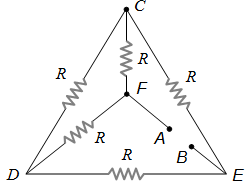
|
(a) |
(b) |
(c) |
(d) |
An electron revolves 6 × 10¹⁵ times/sec in circular loop. The current in the loop is
|
(a) 0.96 mA |
(b) 0.96 m A |
(c) 28.8 A |
(d) None of these |
The inward and outward electric flux for a closed surface in units of  are respectively
  and
and  Then the total charge inside the surface is [where
  = permittivity constant]
|
(a) |
(b) - |
(c) |
(d) |
Three capacitors of capacitance 3 μF , 10 μF and 15 μF are connected in series to a voltage source of 100V. The charge on 15 μF is
|
(a) 50 μC |
(b) 100 μC |
(c) 200 μC |
(d) 280 μC |
For a thermocouple, the neutral temperature is 270℃ and the temperature of its cold junction is 20℃. If there is no deflection in the galvanometer, the temperature of the hot junction should be
|
(a) 210 ℃ |
(b) 540 ℃ |
(c) 520 ℃ |
(d) 209 ℃ |
The plate current in a triode is given by  where Ip, Vp and Vg are the values of plate current, plate voltage and grid voltage, respectively. What are the triode parameters m, rp and gm for the operating point at
  and
and  ?
?
|
(a) 10, 16.7 kW, 0.6 m mho |
(b) 15, 16.7 kW, 0.06 m mho |
|
(c) 20, 6 kW, 16.7 m mho |
(d) None of these |


