MCQ
A square planar complex is formed by hybridisation of which atomic orbitals
  • A
    $s,\,\,{p_x},\,\,{p_y},\,\,{d_{yz}}$
  • $s,\,\,{p_x},\,\,{p_y},\,\,{d_{{x^2} - {y^2}}}$
  • C
    $s,\,\,{p_x},\,\,{p_{y,\,\,}}{d_{{z^2}}}$
  • D
    $s,\,\,{p_y},\,\,{p_z},{d_{xy}}$

Answer

Correct option: B.
$s,\,\,{p_x},\,\,{p_y},\,\,{d_{{x^2} - {y^2}}}$
(b)For square planar geometry hybridization is $ds{p^2}$involving $s$,${p_x},\,{p_y}$ and ${d_{{x^2} - }}_{{y^2}}$ orbital.

Need a full question paper?

Generate a complete, print-ready paper with questions like this in minutes — across 16+ boards, with answer keys.
Start Generating Free

Similar questions

Solid $Ba(NO_3)_2$ is gradually dissolved in a $1.0 \times 10^{-4}\, M\, Na_2CO_3$ solution. At which concentration of $Ba^{2+}$, precipitate of $BaCO_3$ begins to form ? $(K_{sp}$ for $BaCO_3 = 5.1 \times 10^{-9})$
If the concentration of glucose $\ce{(C_6H_{12}O_6)}$ in blood is $0.9gL^{-1}$, what will be the molarity of glucose in blood?
When an electron moves from $L-$ shell to $M-$ shell, then it will be accompanied by :
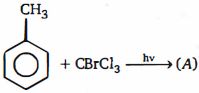
(no ring substitution) Product $(A)$ is
$CNG$ is an important transportation fuel. When $100 \,g$ $CNG$ is mixed with $208$ oxygen in vehicles, it leads to the formation of $CO _{2}$ and $H _{2} O$ and produces large quantity of heat during this combustion, then the amount of carbon dioxide, produced in grams is  ...... [nearest integer] [Assume CNG to be methane]
Which of the following compounds would you expect to be strongest carbon acid ?
Why are strong acids generally used as standard solutions in acid-base titrations
For hydrogen atom, energy of an electron in first excited state is $-3.4 \mathrm{eV}, \mathrm{KE}$. of the same electron of hydrogen atom is $\mathrm{x} \mathrm{eV}$. Value of $\mathrm{x}$ is. . . . . . .$\times 10^{-1} \mathrm{eV}$. (Nearest integer)
Which amongst the following is the strongest acid?
The molar heat of formation of $NH_4NO_{3(s)}$ is $-367.54\,kJ$ and those of $N_2O_{(g)}$ and $H_2O_{(l)}$ are $+ 81.46\,kJ$ and $-285.78\,kJ$ respectively at $25\,^oC$ and $1.0$ atmospheric pressure. Calculate $\Delta U$ at $25\,^oC$ for the reaction

$NH_4NO_{3(s)} \to N_2O_{(g)} + 2H_2O_{(l)}$ .....$kJ$