MCQ
A standing wave having $3$ nodes and $2$ antinodes is formed between two atoms having a distance $1.21 \mathring A $ between them. The wavelength of the standing wave is
  • $1.21 \mathring A$
  • B
    $2.42 \mathcal{A}$
  • C
    $6.05 \mathring A$
  • D
    $3.63 A$

Answer

Correct option: A.
$1.21 \mathring A$

Need a full question paper?

Generate a complete, print-ready paper with questions like this in minutes — across 16+ boards, with answer keys.
Start Generating Free

Similar questions

A constant voltage is applied between the two ends of a metallic wire. If both the length and the radius of the wire are doubled, the rate of heat developed in the wire
In a common base amplifier the phase difference between the input signal voltage and the output voltage is
A wave represented by the given equation $y=a \cos (k x-\omega t)$ is superposed with another wave to form a stationary wave such that the point $x=0$ is a node. The equation for the other wave is
A glass flask of volume one litre at $0^{\circ} \mathrm{C}$ is filled, level full of mercury at this temperature. The flask and mercury are now heated to $100^{\circ} \mathrm{C}$. How much mercury will spill out, if coefficient of volume expansion of mercury is $1.82 \times 10^{-4} /{ }^{\circ} \mathrm{C}$ and linear expansion of glass is $0.1 \times 10^{-4} /{ }^{\circ} \mathrm{C}$ respectively
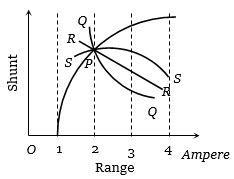
The ammeter has range $1\, ampere$ without shunt. the range can be varied by using different shunt resistances. The graph between shunt resistance and range will have the nature
The electrochemical equivalent $Z$ of any element can be obtained by multiplying the electrochemical equivalent of hydrogen with
The pointer of a dead-beat galvanometer gives a steady deflection because
Image formed by a concave mirror of focal length $6 \mathrm{~cm}$, is $3$ times of the object, then the distance of object from mirror is
A circular coil of radius $4\, cm$ and of $20$ $turns$ carries a current of $3$ amperes. It is placed in a magnetic field of intensity of $0.5$ $weber/{m^2}$. The magnetic dipole moment of the coil is.......$ampere - {m^2}$
If a cycle wheel of radius $4 m$ completes one revolution in two seconds. Then acceleration of a point on the cycle wheel will be