Question
A stationary charge produces only an electrostatic field while a charge in uniform motion produces a magnetic field, that does not change with time. An oscillating charge is an example of accelerating charge. It produces an oscillating magnetic field, which in turn produces an oscillating electric fields and so on. The oscillating electric and magnetic fields regenerate each other as a wave which propagates through space.
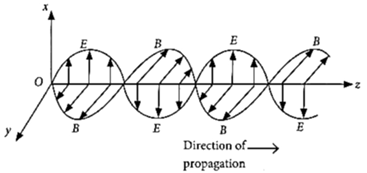
Image
$(i).$ Magnetic field in a plane electromagnetic wave is given by $\vec{B}= B _0 \sin ( kx +\omega t ) \hat{j} T$Expression for corresponding electric field will be (Where c is speed of light.)
$(a) \vec{E}= B _0 c \sin ( kx +\omega t ) \hat{k} V / m$
$(b) \vec{E}=- B _0 c \sin ( kx -\omega t ) \hat{k} V / m$
$(c) \vec{E}=- B _0 c \sin ( kx +\omega t ) \hat{k} V / m$
$(d) \vec{E}=\frac{B_0}{c} \sin ( kx +\omega t ) \hat{k} V / m$
$(ii)$ The electric field component of a monochromatic radiation is given by $\vec{E}=2 E _0 \hat{i} \cos kz \cos \omega t$. Its magnetic field $\vec{B}$ is then given by
$(a) -\frac{2 E_0}{c} \hat{j} \sin kz \sin \omega t$
$(b) \frac{2 E_0}{c} \hat{j} \sin kz \sin \omega t$
$(c) \frac{2 E_0}{c} \hat{j} \sin kz \cos \omega t$
$(d) \frac{2 E_0}{c} \hat{j} \cos kz \cos \omega t$
$(iii)$ A plane em wave of frequency $25 \ MHz$ travels in a free space along $x -$direction. At a particular point in space and time, $E =(6.3 \hat{j}) V / m$. What is magnetic field at that time?
$(a) \ 0.089 \mu T$
$(b) \ 0.124 \mu T$
$(c) \ 0.021 \mu T$
$(d) \ 0.095 \mu T$
OR
A plane electromagnetic wave travels in free space along $x-$axis. At a particular point in space, the electric field along $y$-axis is $9.3 V m ^{-1}$. The magnetic induction $(B)$ along $z -$axis is
$(a) \ 3.1 \times 10^{-8} T$
$(b) \ 3 \times 10^{-5} T$
$(c) \ 3 \times 10^{-6} T$
$(d) \ 9.3 \times 10^{-6} T$
$(iv)$ A plane electromagnetic wave travelling along the $x-$direction has a wavelength of $3 \ mm$ . The variation in the electric field occurs in the $y-$direction with an amptitude $66 V m ^{-1}$. The equations for the electric and magnetic fields as a function of $x$ and $t$ are respectively
$ \text { a) } E_y =11 \cos 2 \pi \times 10^{11}\left(t-\frac{x}{c}\right), \text { b) } E_y =66 \cos 2 \pi \times 10^{11}\left(t-\frac{x}{c}\right),$
$B_y =11 \times 10^{-7} \cos 2 \pi \times 10^{11}\left(t-\frac{x}{c}\right) B_z =2.2 \times 10^{-7} \cos 2 \pi \times 10^{11}\left(t-\frac{x}{c}\right)$
$\text { c) } E_x =33 \cos \pi \times 10^{11}\left(t-\frac{x}{c}\right), \text { d) } E_y =33 \cos \pi \times 10^{11}\left(t-\frac{x}{c}\right),$
$B_x =11 \times 10^{-7} \cos \pi \times 10^{11}\left(t-\frac{x}{c}\right) B_z =1.1 \times 10^{-7} \cos \pi \times 10^{11}\left(t-\frac{x}{c}\right)$
Answer

A stationary charge produces only an electrostatic field while a charge in uniform motion produces a magnetic field, that does not change with time. An oscillating charge is an example of accelerating charge. It produces an oscillating magnetic field, which in turn produces an oscillating electric fields and so on. The oscillating electric and magnetic fields regenerate each other as a wave which propagates through space. 
Image
$(i)  \ (a) \vec{E}= B _0 c \sin ( kx +\omega t ) \hat{k} V / m$
Explanation: Given : $\vec{B}= B _0 \sin ( kx +\omega t ) \hat{j} T$
The relation between electric and magnetic field is, $c =\frac{E}{B}$ or $E = cB$
The electric field component is perpendicular to the direction of propagation and the direction of magnetic field. Therefore, the electric field component along $z-$axis is obtained as $\vec{E}= cB _0 \sin ( kx +\omega t ) \hat{k} V / m$
$(ii) \ (b) \frac{2 E_0}{c} \hat{j} \sin kz \sin \omega t$
Explanation: $\frac{d E}{d z}=-\frac{d B}{d t}$
$\frac{d E}{d z}=-2 E _0 k \sin kz \cos \omega t =-\frac{d B}{d t}$
$dB =+2 E _0 k \sin kz \cos \omega tdt$
$B =+2 E _0 k \sin kz \int \cos \omega tdt =+2 E _0 \frac{k}{\omega} \sin kz \sin \omega t$ $\frac{E_0}{B_0}=\frac{\omega}{k}=c$
$B =\frac{2 E_0}{c} \sin kz \sin \omega t \therefore \vec{B}=\frac{2 E_0}{c} \sin kz \sin \omega t \hat{j}$
$E$ is along $y$-direction and the wave propagates along $x$-axis.
$\therefore B$ should be in a direction perpendicular to both $x-$and $y-$axis.
$(iii) \ (c) 0.021 \mu T$
Explanation: Here, $E =6.3 \hat{j} ; c =3 \times 10^8 m / s$
The magnitude of $B$ is
$B_{Z}=\frac{E}{c}=\frac{6.3}{3 \times 10^8}=2.1 \times 10^{-8} T=0.021 \mu T$
OR
$(a) \ 3.1 \times 10^{-8} T$
Explanation: At a particular point, $E =9.3 V m ^{-1}$
$\therefore$ Magnetic field at the same point $=\frac{9.3}{3 \times 10^8}$
$=3.1 \times 10^{-8} T$
$(iv) \ (b) E_y=66 \cos 2 \pi \times 10^{11}\left(t-\frac{x}{c}\right), B_z=2.2 \times 10^{-7} \cos 2 \pi \times 10^{11}\left(t-\frac{x}{c}\right)$
Explanation: Here : $E _0=66 Vm ^{-1}, E _y=66 \cos \omega\left(t-\frac{x}{c}\right)$,
$\lambda=3 mm=3 \times 10^{-3} m, k=\frac{2 \pi}{\lambda}$
$\frac{\omega}{k}=c \Rightarrow \omega=ck=3 \times 10^8 \times \frac{2 \pi}{3 \times 10^{-3}}$
$\text { or } \omega=2 \pi \times 10^{11}$
$\therefore E _{ y }=66 \cos 2 \pi \times 10^{11}\left(t-\frac{x}{c}\right)$
$B _{ z }=\frac{E_y}{c}=\left(\frac{66}{3 \times 10^8}\right) \cos 2 \pi \times 10^{11}\left(t-\frac{x}{c}\right)$
$=2.2 \times 10^{-7} \cos 2 \pi \times 10^{11}\left(t-\frac{x}{c}\right)$

Need a full question paper?

Generate a complete, print-ready paper with questions like this in minutes — across 16+ boards, with answer keys.

Start Generating Free

Similar questions

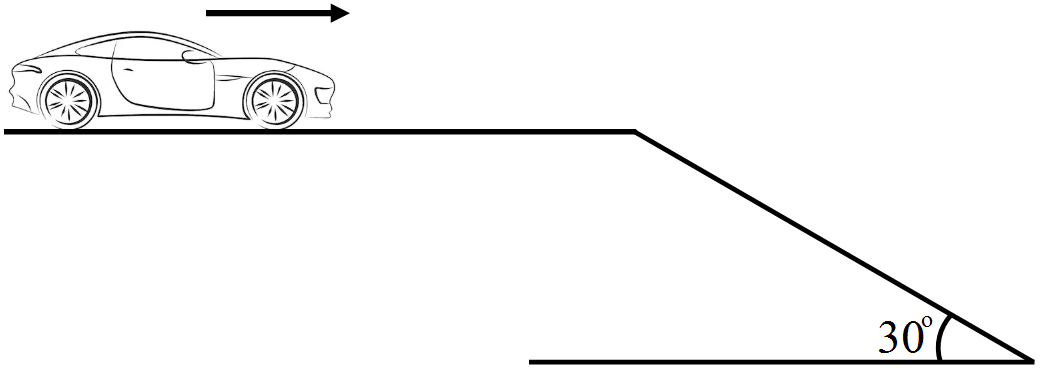
A car is going at a speed of 21.6km/hr when it encounters a 12.8m long slope of angle 30°. The friction coefficient between the road and the tyre is $\frac{1}{2\sqrt{3}}.$ Show that no matter how hard the driver applies the brakes, the car will reach the bottom with a speed greater than 36km/hr. Take $g = 10m/s^2.$
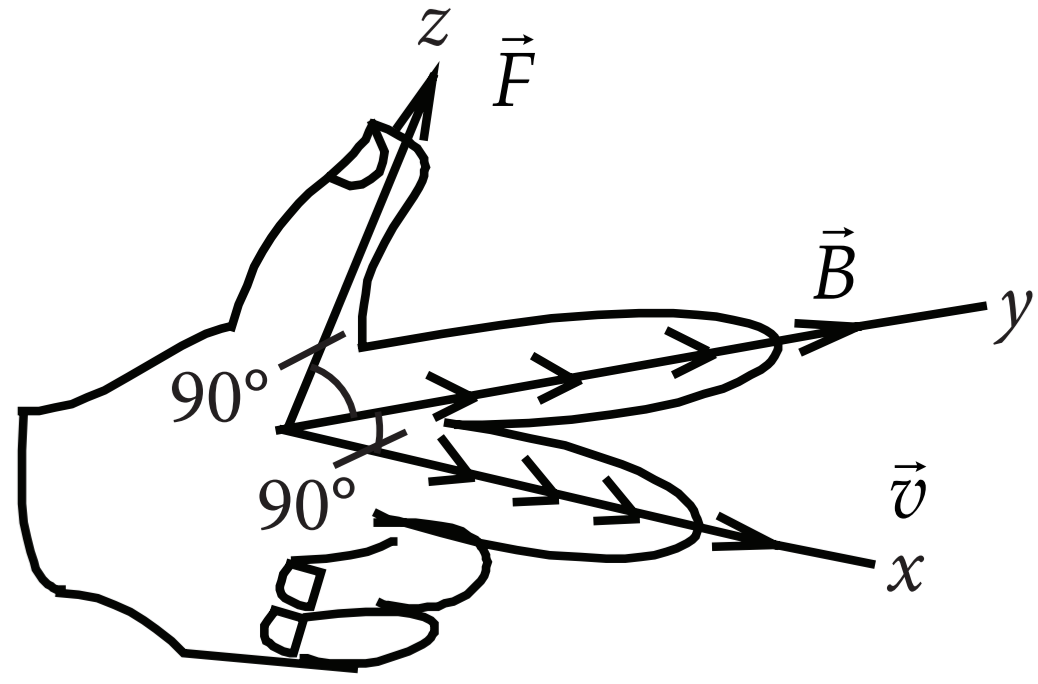
A charged particle moving in a magnetic field experiences a force that is proportional to the strength of the magnetic field, the component of the velocity that is perpendicular to the magnetic field and the charge of the particle. This force is given by $\vec{\text{F}}=\text{q}(\vec{\text{v}}\times\vec{\text{B}})$ where q is the electric charge of the particle, v is the instantaneous velocity of the particle, and Bis the magnetic field (in tesla). The direction of force is determined by the rules of cross product of two vectors. Force is perpendicular to both velocity and magnetic field. Its direction is same as $\vec{\text{v}}\times\vec{\text{B}}$ if q is positive and opposite of $\vec{\text{v}}\times\vec{\text{B}}$ if q is negative. The force is always perpendicular to both the velocity of the particle and the magnetic field that created it. Because the magnetic force is always perpendicular to the motion, the magnetic field can do no work on an isolated charge. It can only do work indirectly, via the electric field generated by a changing magnetic field.
  1. When a magnetic field is applied on a stationary electron, it:
  1. Remains stationary.
  2. Spins about its own axis.
  3. Moves in the direction of the field.
  4. Moves perpendicular to the direction of the field.
  1. A proton is projected with a uniform velocity v along the axis of a current carrying solenoid, then,
  1. The proton will be accelerated along the axis.
  2. The proton path will be circular about the axis.
  3. The proton moves along helical path.
  4. The proton will continue to move with velocity v along the axis.
  1. A charged particle experiences magnetic force in the presence of magnetic field. Which of the following statement is correct?
  1. The particle is stationary and magnetic field is perpendicular.
  2. The particle is moving and magnetic field is perpendicular to the velocity.
  3. The particle is stationary and magnetic field is parallel.
  4. The particle is moving and magnetic field is parallel to velocity.
  1. A charge q moves with a velocity $2m\ s^{-1}$ along x-axis in a uniform magnetic field $\vec{\text{F}}=(\vec{\text{i}}+2\vec{\text{j}}+3\vec{\text{k}})\text{T,}$ charge will experience a force.
  1. In z-y plane.
  2. Along -y axis.
  3. Along +z axis.
  4. Along -z axis.
  1. Moving charge will produce.
  1. Electric field only.
  2. Magnetic field only.
  3. Both electric and magnetic field.
  4. None of these.
All the known radiations from a big family of electromagnetic waves which stretch over a large range of wavelengths. Electromagnetic wave include radio waves, microwaves, visible light waves, infrared rays, UV rays, X-rays and gamma rays. The orderly distribution of the electromagnetic waves in accordance with their wavelength or frequency into distinct groups having widely differing properties is electromagnetic spectrum.
  1. Which wavelength of the Sun is used finally as electric energy?
  1. Radio waves.
  2. Nfrared waves.
  3. Visible light.
  4. Microwaves.
  1. Which of the following electromagnetic radiations have the longest wavelength?
  1. X-rays.
  2. $\gamma-\text{rays}.$
  3. Microwaves.
  4. Radiowaves.
  1. Which one of the following is not electromagnetic in nature?
  1. X-rays.
  2. Gamma rays.
  3. Cathode rays.
  4. Infrared rays.
  1. Which of the following has minimum wavelength?
  1. X-rays.
  2. Ultraviolet rays.
  3. $\gamma-\text{rays}.$
  4. Cosmic rays.
  1. The decreasing order of wavelength of infrared, microwave, ultraviolet and gamma rays is:
  1. Microwave, infrared, ultraviolet, gamma rays.
  2. Gamma rays, ultraviolet, infrared, microwave.
  3. Microwave, gamma rays, infrared, ultraviolet.
  4. Infrared, microwave, ultraviolet, gamma rays.
A magnetic dipole of magnetic moment $1.44A-m^2$ is placed horizontally with the north pole pointing towards north. Find the position of the neutral point if the horizontal component of the earth's magnetic field is $18 \mu\text{T}.$
Two long bar magnets are placed with their axes coinciding in such a way that the north pole of the first magnet is 2·0cm from the south pole of the second. If both the magnets have a pole strength of 10A-m, find the force exerted by one magnet on the other.
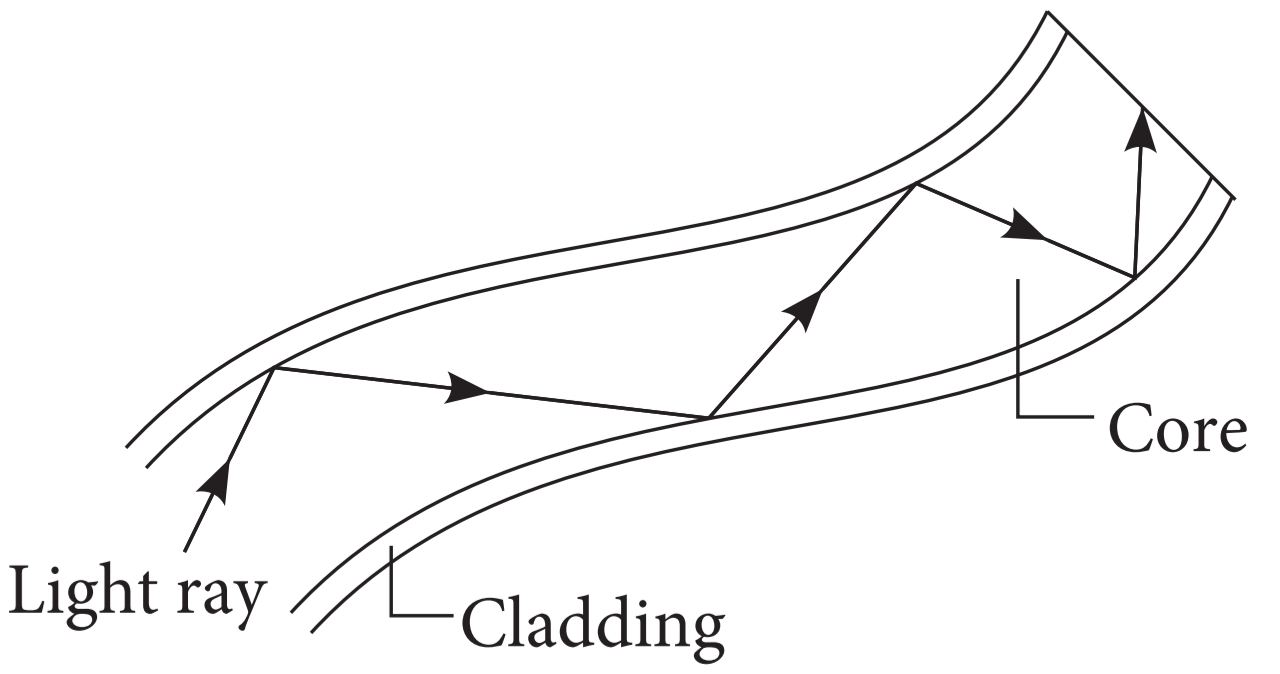
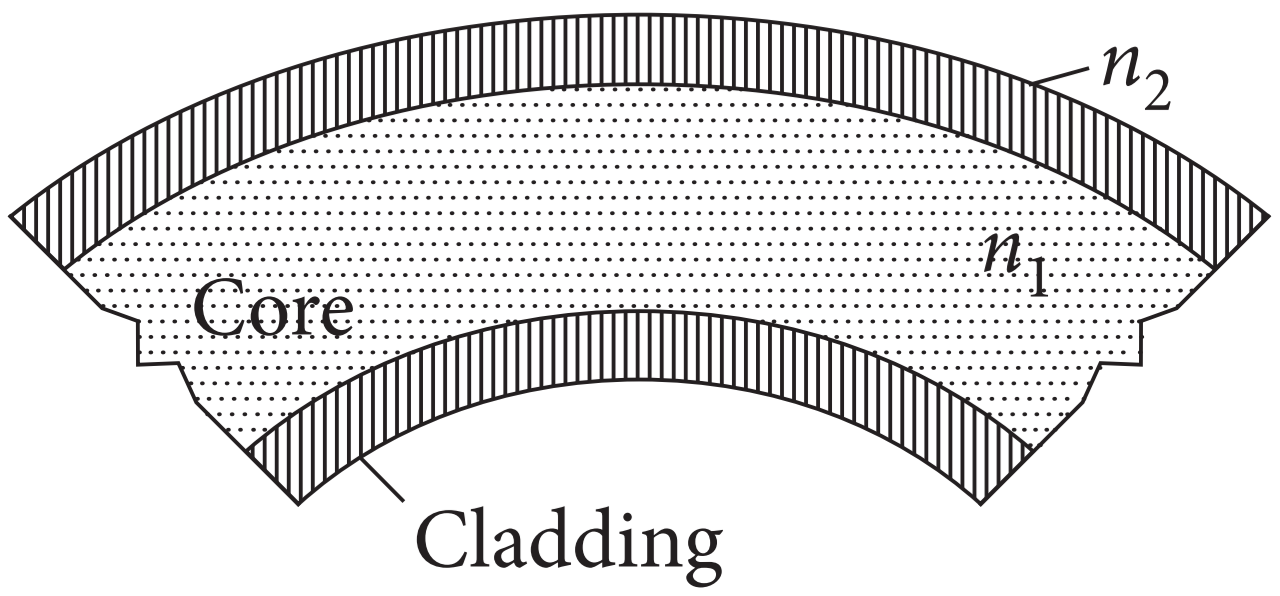
An optical fibre is a thin tube of transparent material that allows light to pass through, without being refracted into the air or another external medium. It make use of total internal reflection. These fibres are fabricated in such a way that light reflected at one side of the inner surface strikes the other at an angle larger than critical angle. Even, if fibre is bent, light can easily travel along the length.
  1. Which of the following is based on the phenomenon of total internal reflection of light?
  1. Sparkling of diamond.
  2. Optical fibre communication.
  3. Instrument used by doctors for endoscopy.
  4. All of these.
  1. A ray of light will undergo total internal reflection inside the optical fibre, if it.
  1. Goes from rarer medium to denser medium.
  2. Is incident at an angle less than the critical angle.
  3. Strikes the interface normally.
  4. Is incident at an angle greater than the critical angle.
  1. If in core, angle of incidence is equal to critical angle, then angle of refraction will be.
  1. $0^\circ$
  2. $45^\circ$
  3. $90^\circ$
  4. $180^\circ$
  1. In an optical fibre (shown), correct relation for refractive indices of core and cladding is:
  1. $n_1 = n_2$
  2. $n_1 > n_2$
  3. $n_1 < n_2$
  4. $n_1 + n_2 = 2$
  1. If the value of critical angle is 300 for total internal reflection from given optical fibre, then speed of light in that fibre is:
  1. $3 \times 10^8ms^{-1}$
  2. $1.5 \times 10^8ms^{-1}$
  3. $6 \times 10^8ms^{-1}$
  4. $4.5 \times 10^8ms^{-1}$

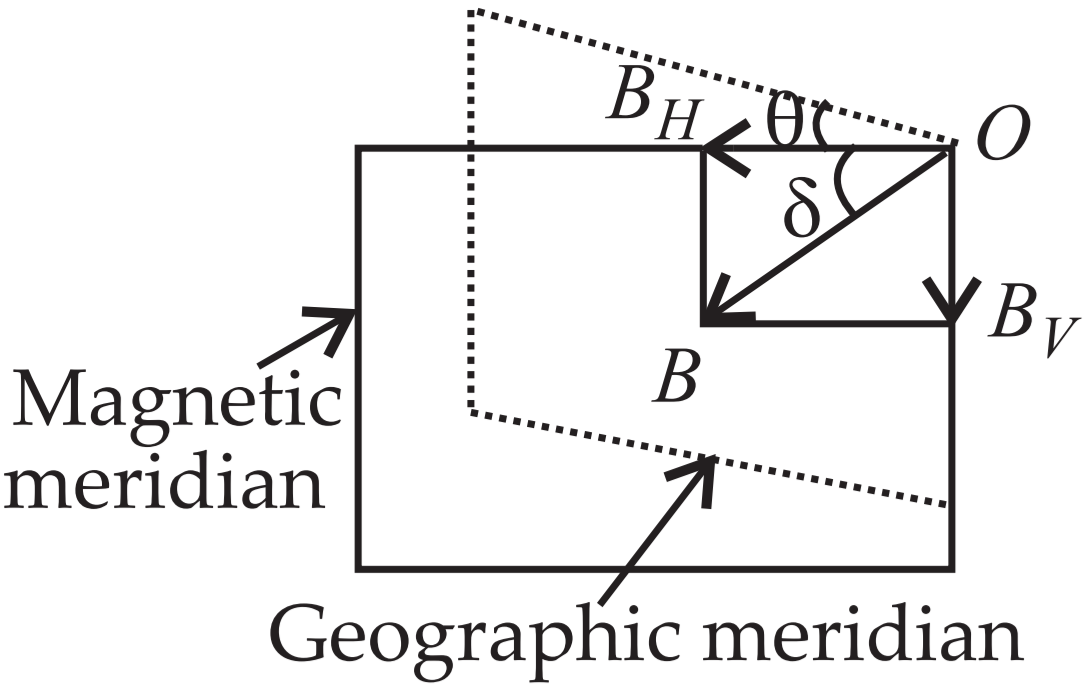
'Tile earth's magnetic field at a point on its surface is usually characterised by three quantities: (a) declination (bl inclination or dip and (cl horizontal component of the field. These are known as the elements of the earth's magnetic field. At a place, angle between geographic meridian and magnetic meridian is defined as magnetic declination, whereas angle made by the earth's magnetic field with the horizontal in magnetic meridian is known as magnetic dip.
  1. In a certain place, the horizontal component of magnetic field is $\frac{1}{\sqrt{3}}$ times the vertical component. 'Tile angle of dip at this place is:
  1. $\text{Zero}$
  2. $\frac{\pi}{3}$
  3. $\frac{\pi}{2}$
  4. $\frac{\pi}{6}$
  1. The angle between the true geographic north and the north shown by a compass needle is called as:
  1. Inclination.
  2. Magnetic declination.
  3. Angle of meridian.
  4. Magnetic pole.
  1. Tile angles of dip at the poles and the equator respectively are
  1. 30º, 30º
  2. 0º, 90º
  3. 45º, 90º
  4. 90º, 0º
  1. A compass needle which is allowed to move in a horizontal plane is taken to a geomagnetic pole. It
  1. Will become rigid showing no movement.
  2. Will stay in any position.
  3. Will stay in north-south direction only.
  4. Will stay in east-west direction only.
  1. Select the correct statement from the following.
  1. The magnetic dip is zero at the centre of the earth.
  2. Magnetic dip decreases as we move away from the equator towards the magnetic pole.
  3. Magnetic dip increases as we move away from the equator towards the magnetic pole.
  4. Magnetic dip does not vary from place to place.
A short magnet oscillates in an oscillation magnetometern with a time period of 0.10s where the earth's horizontal magnetic field is $24\mu\text{T}.$ A downward current of 18 A is established in a vertical wire placed 20cm east of the magnet. Find the new time period.
A small coin is placed on a record rotating at $33\frac{1}{3}$ rev/ minute. The coin does not slip on the record. Where does it get the required centripetal force from?
An astronomical telescope is an optical instrument which is used for observing distinct images of heavenly bodies libe stars, planets etc. It consists of two lenses. In normal adjustment of telescope, the final image is formed at infinity. Magnifying power of an astronomical telescope in normal adjustment is defined as the ratio of the angle subtended at the eye by the angle subtended at the eye by the final image to the angle subtended at the eye, by the object directly, when the final image and the object both lie at infinite distance from the eye. It is given by, $\text{m}=\frac{\text{f}_0}{\text{f}_\text{g}}.$ To increase magnifying power of an astronomical telescope in normal adjustment, focal length of objective lens should be large and focal length of eye lens should be small.
  1. An astronomical telescope of magnifying power 7 consists of the two thin lenses 40cm apart, in normal adjustment. The focal lengths of the lenses are
  1. 5cm, 35cm
  2. 7cm, 35cm
  3. 17cm, 35cm
  4. 5cm, 30cm
  1. An astronomical telescope has a magnifying power of 10. In normal adjustment, distance between the objective and eye piece is 22cm. The focal length of objective lens is:
  1. 25cm
  2. 10cm
  3. 15cm
  4. 20cm
  1. In astronomical telescope compare to eye piece, objective lens has:
  1. Negative focal length.
  2. Zero focal length.
  3. Small focal length.
  4. Large focal length.
  1. To see stars, use:
  1. Simple microscope.
  2. Compound microscope.
  3. Endoscope.
  4. Astronomical telescope.
  1. For large magnifying power of astronomical telescope.
  1. $f_0 << f_e$
  2. $f_0 << f_e$
  3. $f_0 << f_e$
  4. None of these.