MCQ
A steady electric current is flowing through a cylindrical conductor.
  • A
    The electric field at the axis of the conductor is zero.
  • B
    The magnetic field at the axis of the conductor is zero.
  • C
    The electric field in the vicinity of the conductor is zero.
  • D
    The magnetic field in the vicinity of the conductor is zero.

Answer

  1. The magnetic field at the axis of the conductor is zero.
  2. The electric field in the vicinity of the conductor is zero.

Explanation:

As the current is flowing through a conductor so it it is distributed only on the surface of the conductor not in the volume of the cylindrical conductor. It is equivalent to charge distribution on a cylindrical sheet for which electric field inside a conducting cylindrical sheet is always zero.

Magnetic fields at any point inside the conducting cylinder is proportional to the distance from the axis of the cylinder.

At the axis, r = 0.

This implies that field will be zero at the axis.

Need a full question paper?

Generate a complete, print-ready paper with questions like this in minutes — across 16+ boards, with answer keys.

Start Generating Free

Similar questions

Which particles will have minimum frequency of revolution when projected with the same velocity perpendicular to a magnetic field

(a)  

(b) Electron

(c) Proton

(d)  

To reduce the ripples in a rectifier circuit with capacitor filter:
In image formation from spherical mirrors, only paraxial rays are considered because they:
  1. Are easy to handle geometrically.
  2. Contain most of the intensity of the incident light.
  3. Form nearly a point image of a point source.
  4. Show minimum dispersion effect.
In the depletion region of a diode:

Assertion  :   A circular loop carrying current lies in XY plane with its center at origin having a magnetic flux in negative Z-axis.

Reason      : Magnetic flux direction is independent of the direction of current in the conductor.

(a) If both assertion and reason are true and the reason is the correct explanation of the assertion

(b) If both assertion and reason are true but reason is not the correct explanation of the assertion.

(c) If assertion is true but reason is false.

(d) If the assertion and reason both are false.

When a plane mirror is placed horizontally on a level ground at a distance of 60 m  from the foot of a tower, the top of the tower and its image in the mirror subtend an angle of 90°  at the eye. The height of the tower will be

(a) 30 m  

(b) 60 m

(c) 90 m  

(d) 120 m

Which of the following graphs shows the variation of magnetic induction B with distance r from a long wire carrying current

(a)

(b)

(c)

(d)

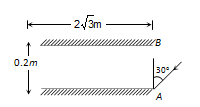
Two plane mirrors. A and B are aligned parallel to each other, as shown in the figure. A light ray is incident at an angle of 30°  at a point just inside one end of A. The plane of incidence coincides with the plane of the figure. The maximum number of times the ray undergoes reflections (including the first one) before it emerges out is

(a) 28

(b) 30

(c) 32

(d) 34

Two charge + q  and  -q  are situated at a certain distance.  At the point exactly midway between them

(a) Electric field and potential both are zero

(b) Electric field is zero but potential is not zero

(c) Electric field is not zero but potential is zero

(d) Neither electric field nor potential is zero

Two wires of resistance R1 and R2 have temperature coefficient of resistance  and , respectively.  These are joined in series.  The effective temperature coefficient of resistance is

(a)

(b)

(c)

(d)