MCQ
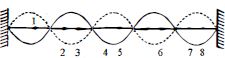
A stretched string is vibrating in its $5^{th}$ harmonic as shown. Consider a particle $1(figure)$. At an instant this particle is at mean positions and is moving towards its negative extreme. Which of the following set of particles, are in same phase with particle $1$
  • A
    $2, 4, 7$
  • B
    $3, 5, 6$
  • $5, 7, 8$
  • D
    $2, 4, 6$

Answer

Correct option: C.
$5, 7, 8$
c
Between $2$ nodes all particle vibrate in same phase

Need a full question paper?

Generate a complete, print-ready paper with questions like this in minutes — across 16+ boards, with answer keys.

Start Generating Free

Similar questions

Suppose that the force of earth's gravity suddenly disappears, choose the correct answer out of the following statements
The coefficient of restitution $e$ for a perfectly elastic collision is
Brakes are being applied in a car moving with speed $20\ m/s$ which produces a retardation of $5\ m/s^2$ . The distance travelled by car till it stops is........$m$
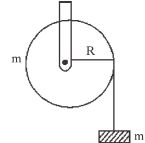
A mass $'m'$ is supported by a massless string wound around a uniform hollow cylinder of mass $m$ and radius $R$. If the string does not slip on the cylinder, with what acceleration will the mass fall on release?
If there is no external force acting on a nonrigid body, which of the following quantities must remain constant?
  1. Angular momentum.
  2. Linear momentum.
  3. Kinetic energy.
  4. Moment of inertia.
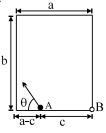
A billiard table whose length and width are as shown in the figure. $A$ ball is placed at point $A$. At what angle ‘$\theta $ ’the ball be projected so that after colliding with two walls, the ball will fall in the pocket $B$ .Assume that all collisions are perfectly elastic (neglect friction)
Three rods made of the same material and having same cross-sectional area but different lengths $10\, cm, 20\, cm$ and $30\, cm$ are joined as shown. The temperature of the junction is......... $^oC$ 
A car is moving with speed of $150\,km / h$ and after applying the brake it will move $27\,m$ before it stops. If the same car is moving with a speed of one third the reported speed then it will stop after travelling $....m$ distance.
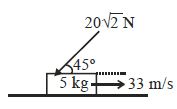
A block of mass $5\, kg$ is kept on a rough horizontal floor. It is given a velocity $33\, m/s$ towards right. A force of $20\sqrt {2\,} \,N$ continuously acts on the block as shown in the figure. If the coefficient of friction between block and floor is $0.5$ the velocity of block after $3\, seconds$ is ........ $m/s$  ($g = 10\, m/s^2$)
A light rod acted upon by three forces, is in equilibrium. Which of the following diagram shows the possible position and direction of the forces?