MCQ
A string $1\,\,m$ long is drawn by a $300\,\,Hz$ vibrator attached to its end. The string vibrates in $3$ segments. The speed of transverse waves in the string is equal to .... $m/s$
  • A
    $100$
  • $200$
  • C
    $300$
  • D
    $400$

Answer

Correct option: B.
$200$
b
$\ell=1 \mathrm{m} \mathrm{f}=300 \mathrm{Hz}$

$\frac{3}{2} \lambda=\ell ; \mathrm{f}=\frac{\mathrm{v}}{\ell} ; \lambda=\frac{2 \ell}{3} ; \mathrm{v}=\mathrm{f} \lambda$

$v=300 \times \frac{2}{3} \times 1=200 \mathrm{m} / \mathrm{s}$

Need a full question paper?

Generate a complete, print-ready paper with questions like this in minutes — across 16+ boards, with answer keys.
Start Generating Free

Similar questions

The viscous force acting between two layers of a liquid is given by $\frac{\text{F}}{\text{A}}=-\eta\frac{\text{dv}}{\text{dz}}$ This $\frac{\text{F}}{\text{A}}$ may be called:
  1. Pressure.
  2. Longitudinal stress.
  3. Tangential stress.
  4. Volume stress.
If height of a satellite from the surface of earth is increased, then its
A particle executing simple harmonic motion along $Y- $axis has its motion described by the equation $y = A\sin (\omega \,t) + B$. The amplitude of the simple harmonic motion is
A satellite orbits around the earth in a circular orbit with a speed v and orbital radius r. If it losses some energy, then v and r changes as:
What happens to the centripetal acceleration of a revolving body if you double the orbital speed $v$ and half the angular velocity $\omega $
An elevator accelerates upwards at a constant rate. A uniform string of length $L$ and mass $m$ supports a small block of mass $M$ that hangs from the ceiling of the elevator. The tension at distance $l$ from the ceiling is $T$ . The acceleration of the elevator is
If the radius and acceleration due to gravity both are doubled, escape velocity of earth will become ......... $km/s$
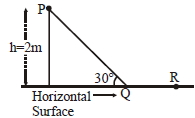
A point particle of mass, moves along the uniformly rough track $PQR$ as shown in the figure. The coefficient of friction, between the particle and the rough track equals $\mu$. The particle is released, from rest, from the point $P$ and it comes to rest at a point $R$. The energies, lost by the ball, over the parts, $PQ$ and $PR$, of the track, are equal to each other, and no energy is lost when particle changes direction from $PQ$ to $QR$. The values of the coefficient of friction $\mu$ and the distance $x(=QR)$ are, respecitvely close to
Different processes are given in Column - $\mathrm{I}$ and its reasons are given in Column - $\mathrm{II}$. Match the appropriately.
Column - $\mathrm{I}$ Column - $\mathrm{II}$
$(a)$Rain drops moves downwards with constant velocity. $(i)$ Viscous liquids
$(b)$ Floating clouds at a height in air. $(ii)$ Viscosity
    $(iiii)$ Less density
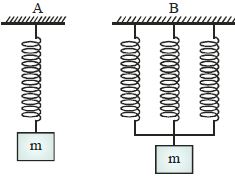
The springs in figure. $A$ and $B$ are identical but length in $A$ is three times that in $B$. The ratio of period $T_A/T_B$ is