Question
A string of length $2 m$ is fixed at both ends. If this string vibrates in its fourth normal mode with a frequency of $500 Hz$ then the waves would travel on its with a velocity of ..... $m/s$

Answer

(c) For string $\lambda = \frac{{2l}}{p}$
where $p =$ No. of loops = Order of vibration
Hence for forth mode $p = 4$

==> $\lambda = \frac{l}{2}$
Hence $v = n\lambda   = 500 \times \frac{2}{2} = 500\,Hz$

Need a full question paper?

Generate a complete, print-ready paper with questions like this in minutes — across 16+ boards, with answer keys.
Start Generating Free

Similar questions

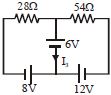
Consider the circuit shown in the figure. The current $I_3$ is equal to
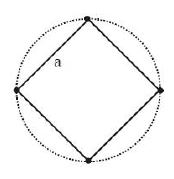
Four identical particles of mass $M$ are located at the corners of a square of side $‘a’$. What should be their speed if each of them revolves under the influence of other’s gravitational field in a circular orbit circumscribing the square?
Assertion : If the distance between parallel plates of a capacitor is halved and dielectric constant is three times, then the capacitance becomes $6\,times$.

Reason : Capacity of the capacitor does not depend upon the nature of the material.

Assertion $(A):$ In a meter bridge experiment, null point for an unknown resistance is put inside an enclosure maintained at a higher temperature. The null point can be obtained at the same $p$ as before by decreasing the value of the standard resistance.

Reason $(R):$ Resistance of metal increases with increase in temperature.
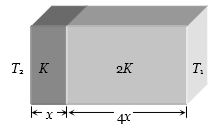
The temperature of the two outer surfaces of a composite slab, consisting of two materials having coefficients of thermal conductivity $K$ and $2K$ and thickness $x$ and $4x$ , respectively are $T_2$ and $T_1$ ($T_2$ > $T_1$). The rate of heat transfer through the slab, in a steady state is $\left( {\frac{{A({T_2} - {T_1})K}}{x}} \right)f$, with $f $ which equal to
A water fountain on the ground sprinkles water all around it. If the speed of water coming out of the fountain is $v$, the total area around the fountain that gets wet is :
If force $\vec{F}=3 \hat{i}+4 \hat{j}-2 \hat{k}$ acts on a particle having position vector $2 \hat{i}+\hat{j}+2 \hat{k}$ then, the torque about the origin will be
An infinitely long hollow conducting cylinder with inner radius $R / 2$ and outer radius $R$ carries a uniform current density along is length. The magnitude of the magnetic field, $|\vec{B}|$ as a function of the radial distance $r$ from the axis is best represented by:
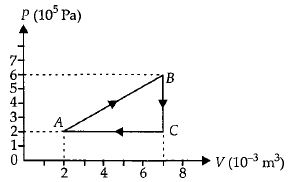
A gas is taken through the cycle $A\to B\to C\to A$ as shown. What is the net work done by the gas ...... $J$ $?$
Hubble's law states that the velocity with which milky way is moving away from the earth is proportional to