Question
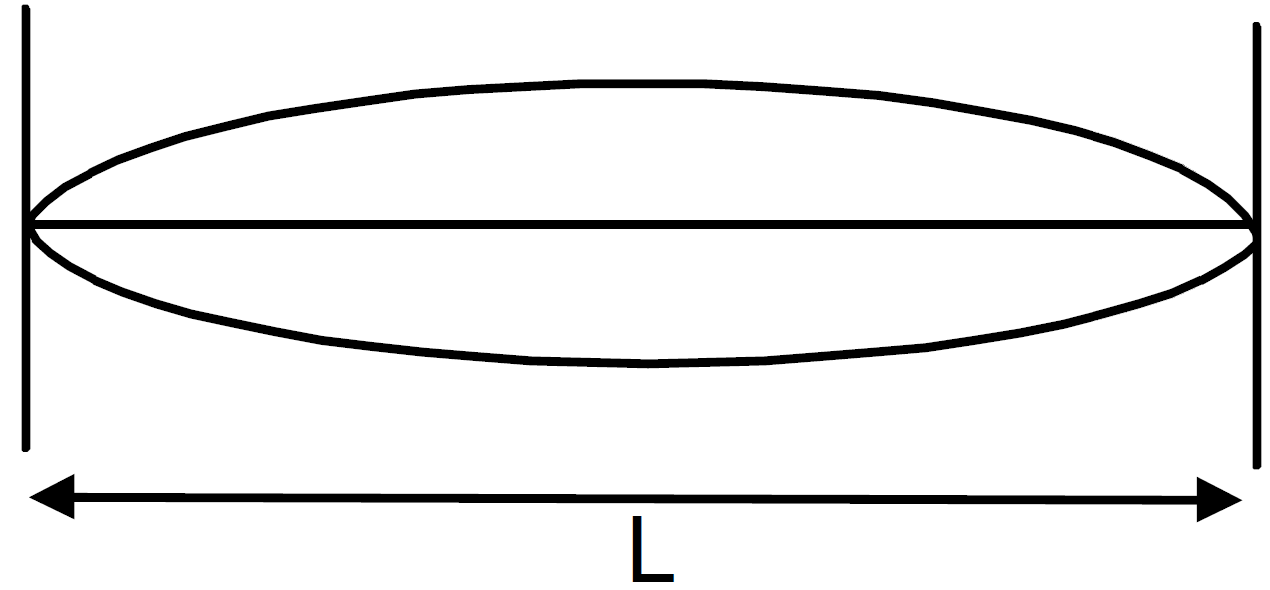
A string of length L fixed at both ends vibrates in its fundamental mode at a frequency v and a maximum amplitude A.
  1. Find the wavelength and the wave number k.
  2. Take the origin at one end of the string and the X-axis along the string. Take the Y-axis along the direction of the displacement. Take t = 0 at the instant when the middle point of the string passes through its mean position and is going towards the positive y-directian. Write the equation describing the standing wave:
Answer

Fundamental frequency

$\text{v}=\frac{1}{2\text{l}}\sqrt{\frac{\text{T}}{\text{m}}}$

$\Rightarrow\sqrt{\frac{\text{T}}{\text{m}}}=\text{v}2\text{l}$ $\Big[\sqrt{\frac{\text{T}}{\text{m}}}=$ velocity of wave$\Big]$

  1. Wavelength, $\lambda=\frac{\text{velocity}}{\text{frequency}}=\frac{\text{v}2\text{l}}{\text{v}}=2\text{l}$

and wave number $\text{K}=\frac{2\pi}{\lambda}=\frac{2\pi}{2\text{l}}=\frac{\pi}{\text{l}}$

  1. Therefore, equation of the stationary wave is

$\text{y}=\text{A}\cos\Big(\frac{2\pi\text{x}}{\lambda}\Big)\sin\Big(\frac{2\pi\text{Vt}}{\text{L}}\Big)$

$=\text{A}\cos\Big(\frac{2\pi\text{x}}{2}\Big)\sin\Big(\frac{2\pi\text{Vt}}{\text{2L}}\Big)$

$\text{v}=\frac{\text{V}}{2\text{L}}$ $\Big[$because $\text{v}=\big(\frac{\text{v}}{2\text{l}}\big)\Big]$

Need a full question paper?

Generate a complete, print-ready paper with questions like this in minutes — across 16+ boards, with answer keys.

Start Generating Free

Similar questions

Two particles. each of mass m and speed v. travel in opposite directions along parallel lines separated by a distance d. Show that the angular momentum vector of the two particle system is the same whatever be the
point about which the angular momentum is taken.
A body of mass ‘m' suspended from a spring executes S.H.M. Calculate the ratio of the kinetic energy and potential energy of the body when it is at half the amplitude far from the mean position.
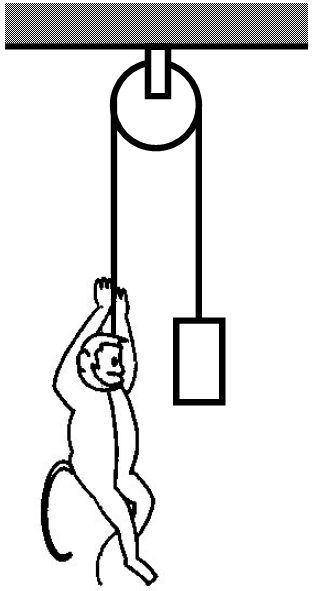
A monkey is climbing on a rope that goes over a smooth light pulley and supports a block of equal mass at the other end figure. Show that whatever force the monkey exerts on the rope, the monkey and the blockmove in the same direction with equal acceleration. If initially both were at rest, their separation will not change as time passes.

A geostationary satellite is orbiting the earth at a height of 6R above the surface of the earth; R being the radius of the earth. What will be the time period of another satellite at a height 2.5R from the surface of the earth?
A cylinder of length l, cross-sectional area A is floating on a liquid of density $\sigma.$ If the cylinder (material density $\rho$) is depressed by a length x further by an external force acting for a short while, estimate the time period of S.H.M.
In one-dimensional motion the velocity of a particle depends on time in the following manner :
$
v=(5 t+7) m / s
$
If the particle is at the origin at $t=0$, then what will be the position of the particle at $t=2 sec$ ?
Suppose the bob of the previous problem has a speed of 1.4m/ s when the string makes an angle of 0.20 radian with the vertical. Find the tension at this instant. You can use $\cos\theta\approx1-\frac{\theta^2}{2}$ and $\sin\theta\approx\theta$ for small $\theta.$
A cricket ball is thrown at a speed of 28m/ s in a direction 30° above the horizontal. Calculate: (a) the maximum height (b) the time taken by the ball to return to the same level (c) the horizontal distance from the thrower to the point where the ball returns to the same level.
Plot the corresponding reference circle for each of the following simple harmonic motions. Indicate the initial (t = 0) position of the particle, the radius of the circle, and the angular speed of the rotating particle. For simplicity, the sense of rotation may be fixed to be anticlockwise in every case: (x is in cm and t is in s).
$\text{x}=2\cos\pi\text{t}$
A wheel of moment of inertia 0.500kg-m2 and radius 20.0cm is rotating about its axis at an angular speed of 20.0rad/s. It picks up a stationary particle of mass 200g at its edge. Find the new angular speed of the wheel.