MCQ
A student obtained a sharp inverted image of a distant tree on a screen placed in front of the concave mirror. He then removed the screen and tried to look into the mirror. He would now see
  • A
    A very blurred image on the wall opposite to the mirror.
  • B
    An erect and magnified image of the tree in the mirror.
  • C
    No image as the screen has been removed.
  • D
    A highly diminished inverted image of the tree at the focus of the mirror.
Answer

  1. A highly diminished inverted image of the tree at the focus of the mirror.
Need a full question paper?

Generate a complete, print-ready paper with questions like this in minutes — across 16+ boards, with answer keys.

Start Generating Free

Similar questions

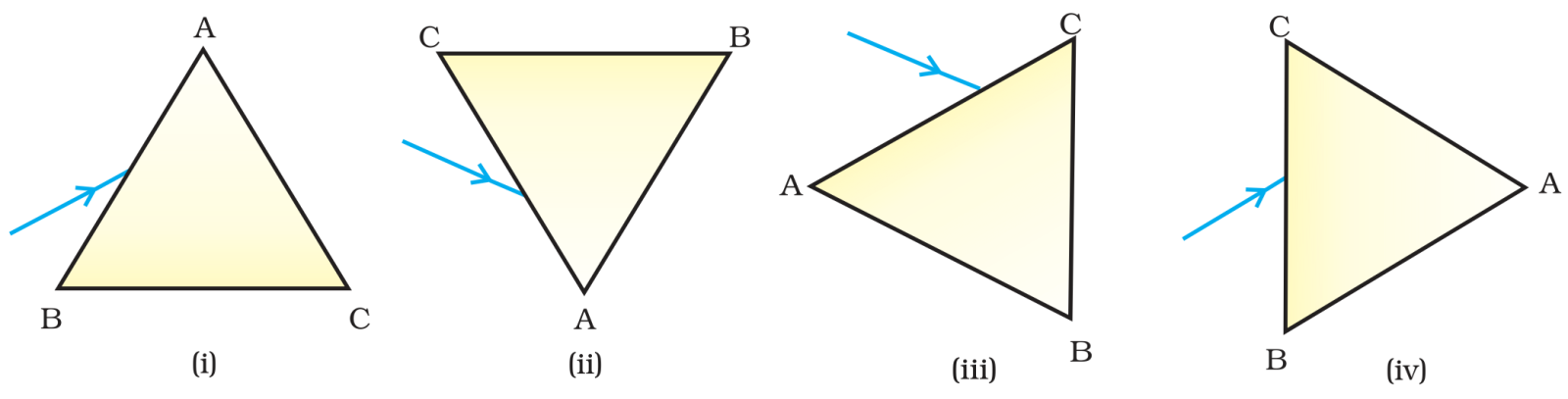
A prism ABC (with BC as base) is placed in different orientations. A narrow beam of white light is incident on the prism as shown in Figure. In which of the following cases, after dispersion, the third colour from the top corresponds to the colour of the sky?

  1. (i)
  2. (ii)
  3. (iii)
  4. (iv)
The power of a converging lens is 4.5D and that of a diverging lens is 3D. The power of this combination of lenses placed close together is:
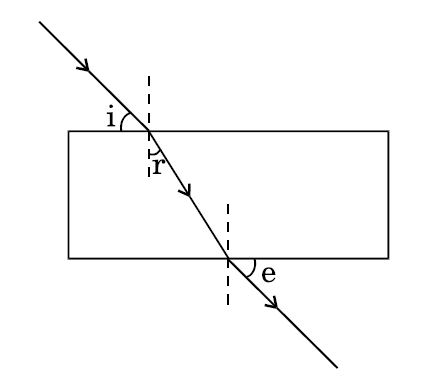
A student traces the path of a ray of light passing through a rectangular glass slab and marks the angle of incidence i, angle of refraction r and angle of emergence e, as shown.

The correctly marked angle(s) is/are:
A student has obtained an image of a distant object on a screen to determine the focal length Fl of the given lens. His teacher after checking the image, gave him another lens of focal length F2 and asked to focus the same object on the same screen. The student found that to obtain a sharp image he has to move the lens away from the screen. From this finding we may conclude that both the lenses given to the student were:
In an electric motor, the direction of current in the coil changes once in each:
Which of the following colour of white light has the least wavelength?
Which of the following statement is correct?
  1. A person with myopia can see distant objects clearly.
  2. A person with hypermetropia can see nearby objects clearly.
  3. A person with myopia can see nearby objects clearly.
  4. A person with hypermetropia cannot see distant objects clearly.
Presence of charge can be correctly identified by.
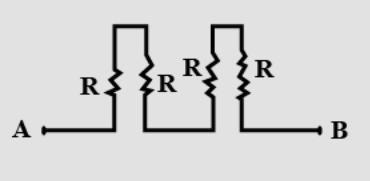
Four identical wires each having resistance R are connected as shown in the figure. Equivalent resistance between A and B is:
Name the material used for making the connection wires: