MCQ
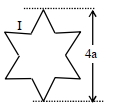
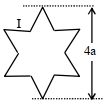
A symmetric star conducting wire loop is carrying a steady state current $\mathrm{I}$ as shown in figure. The distance between the diametrically opposite vertices of the star is $4 a$. The magnitude of the magnetic field at the center of the loop is
  • $\frac{\mu_0 \mathrm{I}}{4 \pi \mathrm{a}} 6[\sqrt{3}-1]$
  • B
    $\frac{\mu_0 \mathrm{I}}{4 \pi \mathrm{a}} 6[\sqrt{3}+1]$
  • C
    $\frac{\mu_0 \mathrm{I}}{4 \pi \mathrm{a}} 3[\sqrt{3}-1]$
  • D
    $\frac{\mu_0 \mathrm{I}}{4 \pi \mathrm{a}} 3[2-\sqrt{3}]$
Answer

Correct option: A.
$\frac{\mu_0 \mathrm{I}}{4 \pi \mathrm{a}} 6[\sqrt{3}-1]$
a
$B=12\left(\frac{\mu_0 I}{4 \pi a}\right)(\sin 60-\sin 30)$

Need a full question paper?

Generate a complete, print-ready paper with questions like this in minutes — across 16+ boards, with answer keys.

Start Generating Free

Similar questions

By a cell a current of 0.9 A flows through 2 ohm resistor and 0.3 A through 7 ohm resistor. The internal resistance of the cell is
What equal length of an iron wire and a copper-nickel alloy wire, each of $2 \; {mm}$ diameter connected parallel to give an equivalent resistance of $3 \Omega ?$

(Given resistivities of iron and copper-nickel alloy wire are $12 \;\mu \Omega {cm}$ and $51\; \mu \Omega {cm}$ respectively) (in ${m}$)

Air is pushed into a soap, bubble of radius r to double its radius. If the surface tension of the soap solution is S, the work done in the process is:
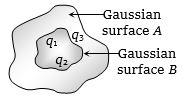
The electric flux for Gaussian surface A that enclose the charged particles in free space is (given $q_1$ = $-14\, nC$, $q_2$ = $78.85\, nC$, $q_3$ = $-56 \,nC$)
According to Gauss’ Theorem, electric field of an infinitely long straight wire is proportional to
Two light waves having the same wavelength $\lambda$ in vacuum are in phase initially. Then the first wave travels a path $L _{1}$ through a medium of refractive index $n_{1}$ while the second wave travels a path of length $L_{2}$ through a medium of refractive index $n _{2}$. After this the phase difference between the two waves is:
Given below are two statements :

Statement $I:$ The law of radioactive decay states that the number of nuclei undergoing the decay per unit time is inversely proportional to the total number of nuclei in the sample.

Statement $II:$ The half life of a radionuclide is the sum of the life time of all nuclei, divided by the initial concentration of the nuclei at time $t =0$.

In the light of the above statements, choose the most appropriate answer from the options given below :

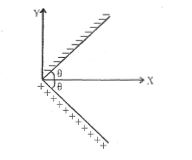
The given diagram shows two semi infinite line of charges having equal (in magnitude) linear charge density but with opposite sign. The electric field at any point on $x$ axis for $(x > 0)$ is along the unit vector
If the binding energy of the electron in a hydrogen atom is 13.6 eV, the energy required to remove the electron from the first excited state of $Li^{++}$ is
Two resistors $A$ and $B$ have resistances $R_A$ and $R_B$, respectively, and $R_A$