MCQ
A system of particles is called a rigid body when:
  • A
    Any two of particles of system may have displacements in opposite directions under action of a force.
  • B
    Any two of particles of system may have velocities in opposite directions under action of a force.
  • C
    Any two particles of system may have a non-zero relative velocity.
  • D
    Any two of particles of system may have displacements in same direction under action of a force.
Answer

  1. Any two particles of system may have a non-zero relative velocity.

Need a full question paper?

Generate a complete, print-ready paper with questions like this in minutes — across 16+ boards, with answer keys.

Start Generating Free

Similar questions

A body of mass 5kg undergoes a change in speed from 30 to 40m/ s. Its momentum would increase by:
If the radius of earth's orbit is made $1\frac{1}{4}$, the duration of an year will become
If between wavelength $\lambda $and $\lambda + d\lambda $, ${e_\lambda }$and ${a_\lambda }$ be the emissive and absorptive powers of a body and ${E_\lambda }$ be the emissive power of a perfectly black body, then according to Kirchoff's law, which is true
A cylindrical metallic rod in thermal contact with two reservoirs of heat at its two ends conducts an amount of heat $Q$ in time $t$. The metallic rod is melted and the material is formed into a rod of half the radius of the original rod. What is the amount of heat conducted by the new rod, when placed in thermal contact with the two reservoirs in time $t$ ?
We have two (narrow) capillary tubes $T_1$ and $T_2$. Their lengths are $l_1$ and $l_2$ and radii of cross-section are $r_1$ and $r_2$ respectively. The rate of flow of water under a pressure difference $ P$  through tube $T_1$ is $8cm ^3/sec$. If $l_1 = 2l_2$ and $ r_1 =r_2$, what will be the rate of flow when the two tubes are connected in series and pressure difference across the combination is same as before $ (= P)$ 
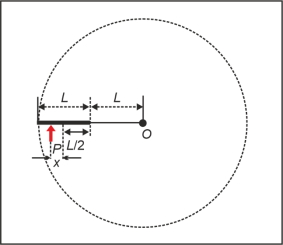
A thin uniform rod of length $L$ and certain mass is kept on a frictionless horizontal table with a massless string of length $L$ fixed to one end (top view is shown in the figure). The other end of the string is pivoted to a point $O$. If a horizontal impulse $P$ is imparted to the rod at a distance $x=L / n$ from the mid-point of the rod (see figure), then the rod and string revolve together around the point $O$, with the rod remaining aligned with the string. In such a case, the value of $n$ is. . . . . . 
If the running bus stop suddenly our feet stop due to friction which does not allow relative motion between the feet and floor of the bus. But the rest of the body continues to move forward due to:
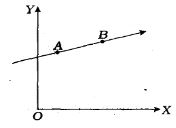
A particle of mass $m$ moves in the $XY$ plane with a velocity $v$ along the straight line $AB.$ If the angular momentum of the particle with respect to origin $O$ is $L_A$ when it is at $A$ and $L_B$ when it is at $B,$ then
A ball moving with a momentum of 5kgm/ s strikes against a wall at an angle of 45° and is reflected at the same angle. The change in momentum will be (kg-m/ s):

The force required to punch a square hole $2\,cm$ side in steel sheet $2\,mm$ thick is (shearing stress of steel sheet $= 3.5\times 10^8\,\,N/m^2$ )