MCQ
A tachometer is a device to measure
  • A
    Speed of rotation
  • Gravitational pull
  • C
    Surface tension
  • D
    Tension in a spring

Answer

Correct option: B.
Gravitational pull
b
A tachometer is an instrument designed to measure the rotation speed of a shaft or disk. Tachometers generally measure rotations per minute $(RPM)$ though some models also serve as rate meters and/or totalizers.

Need a full question paper?

Generate a complete, print-ready paper with questions like this in minutes — across 16+ boards, with answer keys.
Start Generating Free

Similar questions

Mark the correct statements:
  1. The nuclear force between two protons is always greater than the electromagnetic force between them.
  2. The electromagnetic force between two protons is always greater than the gravitational force between them.
  3. The gravitational force between two protons may be greater than the nuclear force between them.
  4. Electromagnetic force between two protons may be greater than the nuclear force acting between them.
Consider two waves passing through the same string. Principle of superposition for displacement says that the net displacement of a particle on the string is sum of the displacements produced by the two waves individually. Suppose we state similar principles for the net velocity of the particle and the net kinetic energy of the particle. Such a principle will be valid for:
  1. Both the velocity and the kinetic energy.
  2. The velocity but not for the kinetic energy.
  3. The kinetic energy but not for the velocity.
  4. Neither the velocity nor the kinetic energy.
$C{O_2}(O - C - O)$ is a triatomic gas. Mean kinetic energy of one gram gas will be (If $N-$Avogadro's number, $k-$Boltzmann's constant and molecular weight of $C{O_2} = 44$)
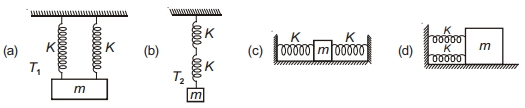
A mass $m$ is attached to two springs of same force constant $K$, as shown in following four arrangements. If $T_1, T_2, T_3$ and $T_4$ respectively be the time periods of oscillation in the following arrangements, in which case time period is maximum?
$4.0 \,g$ of a gas occupies $22.4$ litres at $NTP.$ The specific heat capacity of the gas at constant volume is $5.0 \,\,J K^{-1} mol^{-1}$. If the speed of sound in this gas at $NTP$ is $952\, m s^{-1}$, then the heat capacity at constant pressure is .... $J K^{-1} mol^{-1}$ (Take gas constant $R = 8.3 \,\,J K^{-1} mol^{-1}$) 
A tuning fork is vibrating at $250\, {Hz}$. The length of the shortest closed organ pipe that will resonate with the tuning fork will be ..... ${cm}$

(Take speed of sound in air as $340\, {ms}^{-1}$ )
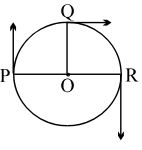
Three point particles $P, Q, R$ move in circle of radius $‘r’$ with different but constant speeds. They start moving at $t = 0$ from their initial positions as shown in the figure. The angular velocities (in rad/ sec) of $P, Q$ and $R$ are $5\pi , 2\pi$ & $3\pi$ respectively, in the same sense.  the number of times $P$ and $Q$ meet in that time interval is:
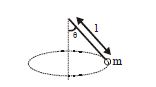
A conical pendulum is moving in a circle with angular velocity $\omega $ as shown. If tension in the string is $T$ , which of following equation are correct?
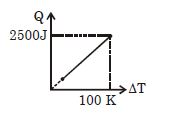
One mole of a gas mixture is heated under constant pressure, and heat supplied $Q$ is plotted against temperature difference acquired. Find the approximate value of $\gamma $ for mixture
Match List $I$ with List $II$.

LIST $-I$ LIST $-II$
$(A)$ Torque $(I)$ $kg\,m ^{-1}\,s ^{-2}$
$(B)$ Energy density $(II)$ $kg\,m\,s^{-1}$
$(C)$ Pressure gradient $(III)$ $kg\,m ^{-2}\,s ^{-2}$
$(D)$ Impulse $(IV)$ $kg\,m ^2\,s ^{-2}$

Choose the correct answer from the options given below