MCQ
A tangent galvanometer shows a deflection $45^o $ when $10\, mA$ current pass through it. If the horizontal component of the earth’s field is $3.6 \times {10^{ - 5}}\,T$ and radius of the coil is $10\, cm$. The number of turns in the coil is......$turns$
  • A
    $5700$ 
  • B
    $57$ 
  • $570$ 
  • D
    $5.7$

Answer

Correct option: C.
$570$ 
c
(c) $K = \frac{{2r{B_H}}}{{{\mu _0}n}}$
or $n = \frac{{2r{B_H}}}{{{\mu _0}K}} = \frac{{2 \times 0.1 \times 3.6 \times {{10}^{ - 5}}}}{{4\pi \times {{10}^{ - 7}} \times 10 \times {{10}^{ - 3}}}}$ $ = \frac{{1.8 \times {{10}^3}}}{{3.14}} = 570$

Need a full question paper?

Generate a complete, print-ready paper with questions like this in minutes — across 16+ boards, with answer keys.

Start Generating Free

Similar questions

According to Mosley's law, the frequency of a spectral line in $X-$ ray spectrum varies as
The idea of secondary wavelets for the propagation of a wave was first given by
A slit of size $0.15 \,cm$ is placed at $2.1\, m$ from a screen. On illuminated it by a light of wavelength $5 × {10^{ - 5}}\, cm$. The width of central maxima will be
Proton $(P)$ and electron $(e)$ will have same deBroglie wavelength when the ratio of their momentum is (assume, $m _{ p }=1849\,m _{ e }$)
An arrangement which consists of two conductors separated by a dielectric medium is called:
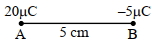
Two particles ${A}$ and ${B}$ having charges $20\, \mu {C}$ and $-5\, \mu {C}$ respectively are held fixed with a separation of $5\, {cm}$. At what position a third charged particle should be placed so that it does not experience a net electric force?
For a radioactive material, its activity $A$ and rate of change of its activity $R$ are defined as $A=-\frac{d N}{d t}$ and $R=-\frac{d A}{d t}$, where $N(t)$ is the number of nuclei at time $t$. Two radioactive sources $P$ (mean life $\tau$ ) and $Q$ (mean life $2 \tau$ ) have the same activity at $t=0$. Their rates of change of activities at $t=2 \tau$ are $R_p$ and $R_Q$, respectively. If $\frac{R_p}{R_Q}=\frac{n}{e}$, then the value of $n$ is
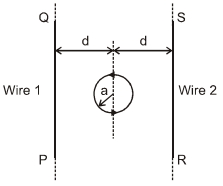
The figure shows a circular loop of radius a with two long parallel wires (numbered $1$ and $2$) all in the plane of the paper. The distance of each wire from the centre of the loop is $d$. The loop and the wires are carrying the same current $I$. The current in the loop is in the counterclockwise direction if seen from above.$Image$

$1.$ When $d \approx$ a but wires are not touching the loop, it is found that the net magnetic filed on the axis of the loop is zero at a height $h$ above the loop. In that case

$(A)$ current in wire $1$ and wire $2$ is the direction $P Q$ and $R S$, respectively and $h \approx a$

$(B)$ current in wire $1$ and wire $2$ is the direction $PQ$ and $SR$, respectively and $h \approx a$

$(C)$ current in wire $1$ and wire $2$ is the direction $PQ$ and $SR$, respectively and $h \approx 1.2 a$

$(D)$ current in wire $1$ and wire $2$ is the direction $PQ$ and $RS$, resepectively and $h \approx 1.2 a$

$2.$ Consider $d \gg a$, and the loop is rotated about its diameter parallel to the wires by $30^{\circ}$ from the position shown in the figure. If the currents in the wires are in the opposite directions, the torque on the loop at its new position will be (assume that the net field due to the wires is constant over the loop)

$(A)$ $\frac{\mu_0 I^2 a^2}{d}$ $(B)$ $\frac{\mu_0 I^2 a^2}{2 d}$ $(C)$ $\frac{\sqrt{3} \mu_0 I^2 a^2}{d}$ $(D)$ $\frac{\sqrt{3} \mu_0 I^2 a^2}{2 d}$

Give the answer question $1$ and $2.$
A convex lens is in contact with concave lens. The magnitude of the ratio of their focal length is 2/3. Their equivalent focal length is 30 cm. What are their individual focal lengths
In a microscope, the focal length of the objective lens in comparison to focal length of the eye lens is :