MCQ
A thick wire is stretched so that its length become two times. Assuming that there is no change in its density, then what is the ratio of change in resistance of wire to the initial resistance of wire
  • A
    $2: 1$
  • B
    $4: 1$
  • $3: 1$
  • D
    $1: 4$

Answer

Correct option: C.
$3: 1$
(c) In stretching $R \propto l^2 \Rightarrow \frac{R_2}{R_1}=\frac{l_2^2}{l_1{ }^2} \Rightarrow \frac{R_2}{R_1}=\left(\frac{2}{1}\right)^2$$\Rightarrow R_2=4 R_1$. Change in resistance $=R_2-R_1=3 R_1$Now, $\frac{\text { Change in resistance }}{\text { Original resistance }}=\frac{3 R_1}{R_1}=\frac{3}{1}$

Need a full question paper?

Generate a complete, print-ready paper with questions like this in minutes — across 16+ boards, with answer keys.
Start Generating Free

Similar questions

An alternating e.m.f. of angular frequency $\omega$ is applied across an inductance. The instantaneous power developed in the circuit has an angular frequency
The amount of charge required to liberate $9 gm$ of aluminium (atomic weight $=27$ and valency $=3$ ) in the process of electrolysis is (Faraday's number $=96500$ coulombs/gm equivalent)
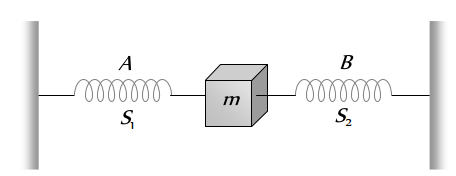
In the figure, $S_1$ and $S_2$ are identical springs. The oscillation frequency of the mass $m$ is $f$. If one spring is removed, the frequency will become

Image

When a ball is thrown up vertically with velocity $V_o$, it reaches a maximum height of ' $h$ '. If one wishes to triple the maximum height then the ball should be thrown with velocity
Which of the transitions in hydrogen atom emits a photon of lowest frequency ( $n=$ quantum number)
Which of the following do not require medium for transmission
Which of the following curves correctly represents the variation of capacitive reactance $X$ with frequency $f$
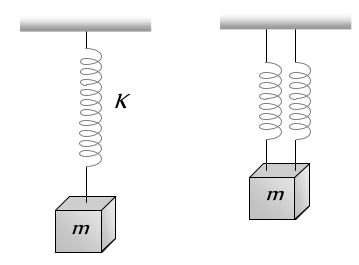
A mass $m$ performs oscillations of period $T$ when hanged by spring of force constant $K$. If spring is cut in two parts and arranged in parallel and same mass is oscillated by them, then the new time period will be Image
Two adjacent piano keys are struck simultaneously. The notes emitted by them have frequencies $n_1$ and $n_2$. The number of beats heard per second is
A force acts on a $30 \mathrm{gm}$ particle in such a way that the position of the particle as a function of time is given by $x=3 t-4 t^2+t^3$, where $x$ is in metres and $t$ is in seconds. The work done during the first 4 seconds is