A thick wire is stretched so that its length become two times. Assuming that there is no change in its density, then what is the ratio of change in resistance of wire to the initial resistance of wire
Medium
Download our app for free and get started
(c) In stretching $R \propto {l^2}$ $ \Rightarrow $ $\frac{{{R_2}}}{{{R_1}}} = \frac{{{l_2}^2}}{{{l_1}^2}}$ $ \Rightarrow $ $\frac{{{R_2}}}{{{R_1}}} = {\left( {\frac{2}{1}} \right)^2}$
$ \Rightarrow $${R_2} = 4{R_1}$. Change in resistance $ = {R_2} - {R_1} = 3{R_1}$
Now, $\frac{{{\rm{Change}}\,\,{\rm{in}}\,\,{\rm{resistance}}}}{{{\rm{Original}}\,\,{\rm{resistance}}}} = \frac{{3{R_1}}}{{{R_1}}} = \frac{3}{1}$

Download our appand get started for free
Experience the future of education. Simply download our apps or reach out to us for more information. Let's shape the future of learning together!No signup needed.*
Similar Questions
- 1The charge flowing in a conductor varies with time as $Q = at -bt^2$. Then for current, which statement is incorrect.View Solution
$(A)$ decreases linearly with time
$(B)$ reaches a maximum and then decreases
$(C)$ fall to zero after time $t = a/2b$
$(D)$ changes at a rate $-2b$
Options : - 2When two resistance are connected in parallel then the equivalent resistance is $\frac {6}{5}\Omega $ . When one of the resistance is removed then the effective resistance is $2\, \Omega $. The resistance of the wire removed will be ................ $\Omega$View Solution
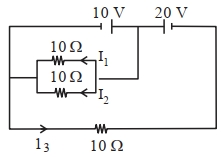
- 3In the given circuit the value of $\left|\frac{I_1+I_3}{I_2}\right|$ isView Solution
- 4The charge flowing through a resistance $R$ varies with time according to $Q = at -bt^2.$ The total heat produced in $R$ is : (assume that direction of current not reversed)View Solution
- 5Four wires of the same diameter are connected in turn between two points, maintained at a constant potential difference. Their resistivities are; $\rho $ and $L$ (wire $1$ )., $1.2\,\rho $ and $1.2\,L$ (wire $2$ ), $0.9\,\rho $ and $0.9\,L$ (wire $3$ ) and $\rho $ and $1.5\,L$ (wire $4$ ). Rank the wires according to the rates at which energy is dissipated as heat, greatest firstView Solution
- 6A wire of resistance $x$ ohm is drawn out, so that its length is increased to twice its original length, and its new resistance becomes $20 \,\Omega$, then $x$ will be ........ $\Omega$View Solution
- 7The resistance of $10\, metre$ long potentiometer wire is $1\,ohm/meter$. A cell of $e.m.f.$ $2.2\, volts$ and a high resistance box are connected in series to this wire. The value of resistance taken from resistance box for getting potential gradient of $2.2\, millivolt/metre$ will be ............... $\Omega $View Solution
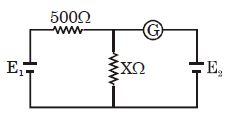
- 8In the adjoining circuit, the battery $E_1$ has an $e.m.f.$ of $12\, volts$ and zero internal resistance, while the battery $E_2$ has an $e.m.f.$ of $2\, volts$. If the galvanometer $G$ reads zero, then the value of the resistance $X$ in $ohms$ isView Solution
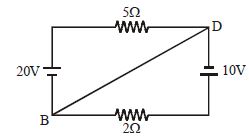
- 9Calculate the current in wire $BD$ ................ $A$View Solution
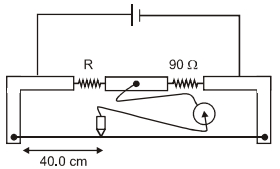
- 10During an experiment with a metre bridge, the galvanometer shows a null point when the joceky is pressed at $40.0 \ cm$ using a standard resistance of $90 \ \Omega$, as shown in the figure. The least count of the scale used in the meter bridge is $1 \ mm$. The unknown resistance is:View Solution