Question
A thin circular loop of radius R rotates about its vertical diameter with an angular frequency $\omega.$ Show that a small bead on the wire loop remains at its lowermost point for $\omega\le\sqrt{\frac{\text{g}}{\text{R}}}.$ What is the angle made by the radius vector joining the centre to the bead with the vertical downward direction for $\omega=\sqrt{\frac{2\text{g}}{\text{R}}}?$ Neglect friction.
Answer

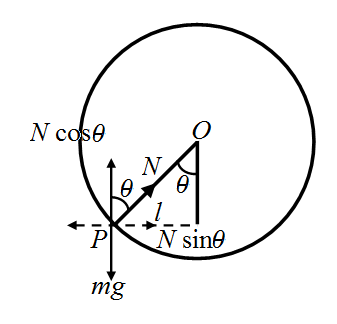
Let the radius vector joining the bead with the centre make an angle $\theta,$ with the vertical downward direction. OP = R = Radius of the circle N = Normal reaction The respective vertical and horizontal equations of forces can be written as: $\text{mg}=\text{N}\cos\theta\ ....(\text{i})$ $\text{ml}\omega=\text{N}\sin\theta\ ...(\text{ii})$ In $\triangle\text{OPQ},$ we have: $\sin\theta=\frac{\text{l}}{\text{R}}$ $\text{l}=\text{R}\sin\theta\ ...(\text{iii})$ Substituting equation (iii) in equation (ii), we get: $\text{m}(\text{R}\sin\theta)\omega^2=\text{N}\sin\theta$ $\text{mR}\omega^2=\text{N}\ ...(\text{iv})$ Substituting equation (iv) in equation (i), we get: $\text{mg}=\text{mR}\omega^2\cos\theta$ $\cos\theta=\frac{\text{g}}{\text{R}\omega^2}\ ...(\text{v})$ Since $\cos\theta\le1,$ the bead will remain at its lowermost point for $\frac{\text{g}}{\text{R}\omega^2\le1},$ i.e., for $\omega\le\Big(\frac{\text{g}}{\text{R}}\Big)^{1/2}$ For $\omega=\Big(\frac{2\text{g}}{\text{R}}\Big)^{1/2}\ \text{or}\ \omega^2=\frac{2\text{g}}{\text{R}}\ ...(\text{vi})$ On equating equations (v) and (vi), we get: $\frac{2\text{g}}{\text{R}}=\frac{\text{g}}{\text{R}\cos\theta}$ $\cos\theta=\frac{1}{2}$ $\therefore\theta=\cos^{-1}(0.5)=60^\circ$
Need a full question paper?

Generate a complete, print-ready paper with questions like this in minutes — across 16+ boards, with answer keys.

Start Generating Free

Similar questions

A 250g block slides on a rough horizontal table. Find the work done by the frictional force in bringing the block to rest if it is initially moving at a speed of 40cm/s. If the friction coefficient between the table and the block is 0.1, how far does the block move before coming to rest?
The two blocks in an Atwood machine have masses $2.0kg$ and $3.0kg$. Find the work done by gravity during the fourth second after the system is released from rest.
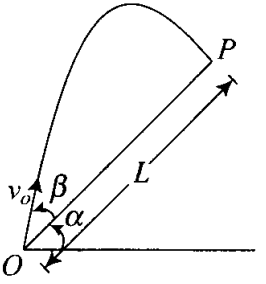
A particle is projected in air at an angle $\beta$ to a surface which itself is inclined at an angle $\alpha$ to the horizontal (Fig.).
  1. Time of flight.
(Hint: This problem can be solved in two different ways:
  1. Point P at which particle hits the plane can be seen as intersection of its trajectory (parobola) and straight line. Remember particle is projected at an angle $(\alpha+\beta)$ w.r.t. horizontal.
  2. We can take x-direction along the plane and y-direction perpendicular to the plane. In that case resolve g (acceleration due to gravity) in two differrent components, $g_x$ along the plane and $g_y$ perpendicular to the plane. Now the problem can be solved as two independent motions in x and y directions respectively with time as a common parameter.)
In a refrigerator one removes heat from a lower temperature and deposits to the surroundings at a higher temperature. In this process, mechanical work has to be done which is provided by an electric motor. If the motor is of $1KW$ power, and heat is transferred from $–3^\circ C to 27^\circ C$, find the heat taken out of the refrigerator per second assuming its efficiency is 50% of a perfect engine.
Explain by giving definition of Bulk Modulus of elasticity, Modulus of Rigidity and compressibility what are their units and dimensions? What is the relation between co-efficient of elasticity $Y , K$ and $\eta$ ?
Describe the working of Carnot engine. Obtain an expression for its efficiency.
In an experiment on the specific heat of a metal, a 0.20 kg block of the metal at $150^{\circ} \mathrm{C}$ is dropped in a copper calorimeter (of water equivalent 0.025 kg ) containing $150 \mathrm{~cm}^3$ of water at $27^{\circ} \mathrm{C}$. The final temperature is $40^{\circ} \mathrm{C}$. Compute the specific heat of the metal. If heat losses to the surroundings are not negligible, is your answer greater or smaller than the actual value for specific heat of the metal?
Two charges $2.0 \times 10^{-6}C$ and $1.0 \times 10^{-6}C$ are placed at a separation of 10cm. Where should a third charge be placed such that it experiences no net force due to these charges?
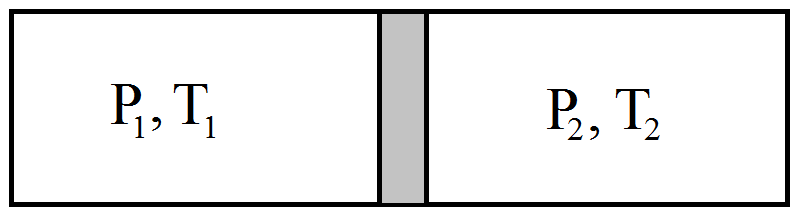
The figure shows an adiabatic cylindrical tube of volume $V_0$ divided in two parts by a frictionless adiabatic separator. Initially, the separator is kept in the middle, an ideal gas at pressure $p_1$ and temperature $T_1$ is injected into the left part and another ideal gas at pressure $p_2$ and temperature $T_2$ is injected into the right part. $\frac{\text{C}_\text{P}}{\text{C}_\text{V}}=\gamma$ is the same for both the gases. The separator is slid slowly and is released at a position where it can stay in equilibrium. Find,
  1. The volumes of the two parts.
  2. The heat given to the gas in the left part.
  3. The final common pressure of the gases.
A block of mass m is kept on a horizontal ruler. The friction coefficient between the ruler and the block is g. The ruler is fixed at one end and the block is at a distance L from the fixed end. The ruler is rotated about the fixed end in the horizontal plane through the fixed end.
  1. What can the maximum angular speed be for which the block does not slip?
  2. If the angular speed of the ruler is uniformly increased from zero at an angular acceleration $\alpha,$ at what angular speed will the block slip?