Question
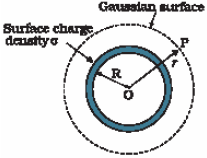
A thin conducting spherical shell of radius R has charge Q spread uniformly over its surface. Using Gauss’s law, derive an expression for an electric field at a point outside the shell.Draw a graph of electric field E(r) with distance r from the centre of the shell for $0\underline{<}\text{r}\underline{<}\infty.$
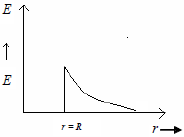
Answer

$\oint\overrightarrow{\text{E}}.\overrightarrow{\text{ds}} = \frac{\text{q}}{\varepsilon_\circ}$$\text{E}\times4\pi\text{r}^{2} =\frac{\text{Q}}{\varepsilon_\circ}$
$\text{E} = \frac{1}{4\pi\varepsilon_\circ}\frac{\text{Q}}{\text{r}^{3}}$

Need a full question paper?

Generate a complete, print-ready paper with questions like this in minutes — across 16+ boards, with answer keys.

Start Generating Free

Similar questions

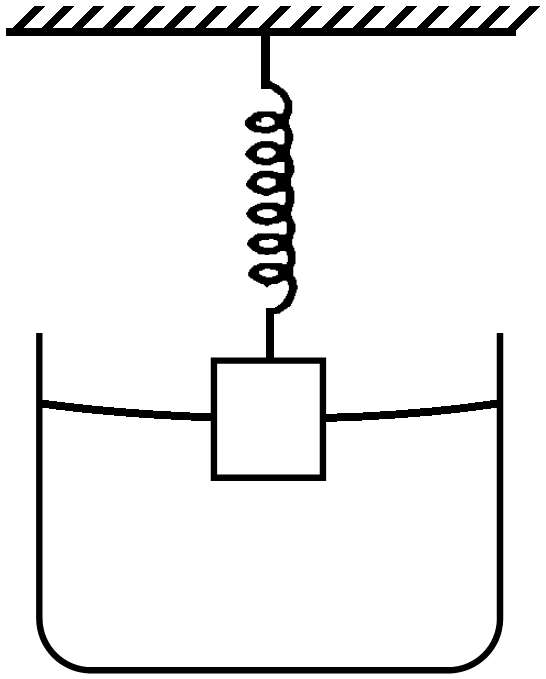
A cylindrical object of outer diameter 10cm, height 20cm and density $8000kg/m^3$ is supported by a vertical spring and is half dipped in water as shown in.
  1. Find the elongation of the spring in equilibrium condition.
  2. If the object is slightly depressed and released, find the time period of resulting oscillations of the object. The spring constant = 500N/m.
A short magnet is moved along the axis of a conducting loop. Show that the loop repels the magnet if the magnet is approaching the loop and attracts the magnet if it is going away from the loop.
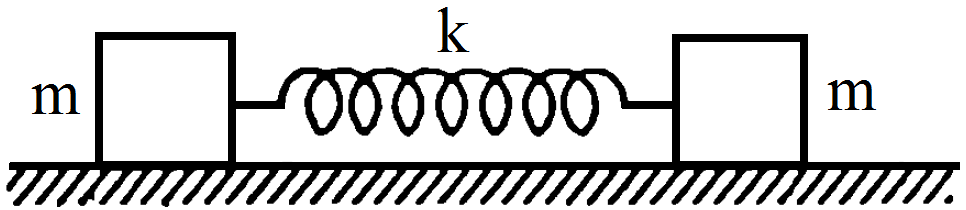
Consider the situation shown in figure Show that if the blocks are displaced slightly in opposite directions and released, they will execute simple harmonic motion. Calculate the time period.
A small telescope has an objective lens of focal length 144 cm and an eyepiece of focal length 6.0 cm. What is the magnifying power of the telescope? What is the separation between the objective and the eyepiece?
Derive the expression for force per unit length between two long straight parallel current carrying conductors. Hence define one ampere.
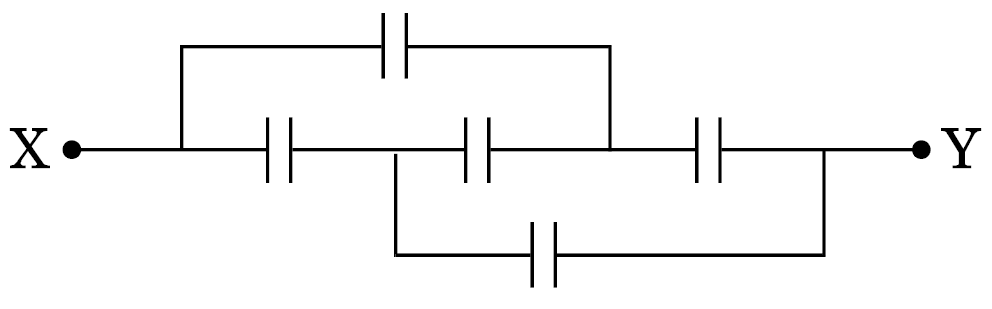
Find the equivalent capacitance of the network shown in the figure, when each capacitor is of $1\mu\text{F}$. When the ends X and Y are connected to a 6 V battery, find out (i) The charge and (ii) The energy stored in the network.
The numerical value of ionization energy in eV equals the ionization potential in volts. Does the equality hold if these quantities are measured in some other units?
We are given the following atomic masses:
${ }_{92}^{238} U=238.05079 u$
${ }_2^4 H e=4.00260 u$
${ }_{90}^{234} Th =234.04363 u$
${ }_1^1 H=1.00783 u$
${ }_{91}^{237} Pa=237.05121 u $
Here the symbol Pa is for the element protactinium $(Z = 91).$
$i.$ Calculate the energy released during the alpha decay of ${ }_{92}^{238} U$.
$ii.$ Calculate the kinetic energy of the emitted $\alpha$-particles.
$iii.$ Show that ${ }_{92}^{238} U$ can not spontaneously emit a proton.
  1. Describe the working principle of a solar cell. Mention three basic processes involved in the generation of emf.
  2. Why are Si and GaAs preferred materials for solar cells?
An electron and alpha particle have the same kinetic energy. How are the de Broglie wavelengths associated with them related?