Question
A thin converging lens is formed with one surface convex and the other plane. Does the position of image depend on whether the convex surface or the plane surface faces the object?

Answer

No, If it is a thin lens then focal length is not effected by from which side ray falls.

Need a full question paper?

Generate a complete, print-ready paper with questions like this in minutes — across 16+ boards, with answer keys.
Start Generating Free

Similar questions

State the number of significant figures in the following: $2.64 \times 10^{24} \mathrm{~kg}$
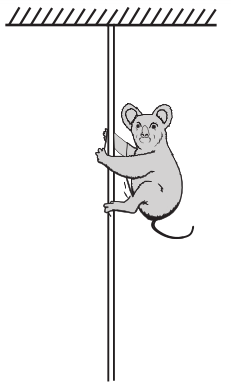
A monkey of mass $40kg$ climbs on a rope $($Fig.$)$ which can stand a maximum tension of $600 N$. In which of the following cases will the rope break: the monkey,

$($Ignore the mass of the rope$)$.
The drift speed is defined as $\text{v}_\text{d}=\frac{\Delta\text{l}}{\Delta\text{t}}$ where $\Delta\text{l}$ is the distance drifted in a long time $\Delta\text{t}.$ Why don't we define the drift speed as the limit of $\frac{\Delta\text{l}}{\Delta\text{t}}\ \text{as}\ \Delta\text{t}\rightarrow0?$
If we use water instead of mercury in a barometer, what will be the height of water?
At what angle should a ball be thrown so that its horizontal range is maximum?
The free surface of a liquid resting in an inertial frame is horizontal. Does the normal to the free surface pass through the centre of the earth? Think separately if the? The free surface of a liquid resting in an inertial frame is horizontal. Does the normal to the free surface pass through the centre of the earth? Think separately if the liquid is.
  1. At the equator.
  2. At a pole.
  3. Somewhere else.
To measure the magnetic moment of a bar magnet, one may use:
  1. A tangent galvanometer.
  2. A deflection galvanometer if the earth's horizontal field is known.
  3. An oscillation magnetometer if the earth's horizontal field is known.
  4. Both deflection and oscillation magnetometer if the earth's horizontal field is not known.
The length covered by a body is found to be directly proportional to the square of time. What is the nature of acceleration?
A person can jump from 5 m height into water but can't jump 5 m height onto a hard floor without water. Why?
The wheels of moving vehicles are made hollow in the middle and thick on the circumference, why?