Question
A thin circular loop of radius R rotates about its vertical diameter with an angular frequency $\omega.$ Show that a small bead on the wire loop remains at its lowermost point for $\omega\le\sqrt{\frac{\text{g}}{\text{R}}}.$ What is the angle made by the radius vector joining the centre to the bead with the vertical downward direction for $\omega=\sqrt{\frac{2\text{g}}{\text{R}}}?$ Neglect friction.
Answer

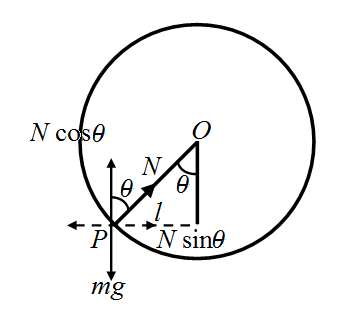
Let the radius vector joining the bead with the centre make an angle $\theta,$ with the vertical downward direction.

OP = R = Radius of the circle
N = Normal reaction
The respective vertical and horizontal equations of forces can be written as:
$\text{mg}=\text{N}\cos\theta\ ....(\text{i})$
$\text{ml}\omega=\text{N}\sin\theta\ ...(\text{ii})$
In $\triangle\text{OPQ},$ we have:
$\sin\theta=\frac{\text{l}}{\text{R}}$
$\text{l}=\text{R}\sin\theta\ ...(\text{iii})$
Substituting equation (iii) in equation (ii), we get:
$\text{m}(\text{R}\sin\theta)\omega^2=\text{N}\sin\theta$
$\text{mR}\omega^2=\text{N}\ ...(\text{iv})$
Substituting equation (iv) in equation (i), we get:
$\text{mg}=\text{mR}\omega^2\cos\theta$
$\cos\theta=\frac{\text{g}}{\text{R}\omega^2}\ ...(\text{v})$
Since $\cos\theta\le1,$ the bead will remain at its lowermost point for $\frac{\text{g}}{\text{R}\omega^2\le1},$ i.e., for $\omega\le\Big(\frac{\text{g}}{\text{R}}\Big)^{1/2}$
For $\omega=\Big(\frac{2\text{g}}{\text{R}}\Big)^{1/2}\ \text{or}\ \omega^2=\frac{2\text{g}}{\text{R}}\ ...(\text{vi})$ 
On equating equations (v) and (vi), we get:
$\frac{2\text{g}}{\text{R}}=\frac{\text{g}}{\text{R}\cos\theta}$
$\cos\theta=\frac{1}{2}$
$\therefore\theta=\cos^{-1}(0.5)=60^\circ$

Need a full question paper?

Generate a complete, print-ready paper with questions like this in minutes — across 16+ boards, with answer keys.

Start Generating Free

Similar questions

Two masses M1 and M2 are connected by a light rod and the system is slipping down a rough incline of angle $\theta$ with the horizontal. The friction coefficient at both the contacts is $\mu.$ Find the acceleration of the system and the force by the rod on one of the blocks.
A wire stretched between two rigid supports vibrates in its fundamental mode with a frequency of 45Hz. The mass of the wire is 3.5 × 10⁻²kg and its linear mass density is 4.0 × 10⁻²kg m–1. What is
  1. The speed of a transverse wave on the string,
  2. The tension in the string?
Two wires, one of steel and the other of aluminium, each 2m long and of diameter 2.0mm, are joined end to end to form a composite wire of length 4.0m. What tension in the wire will produce a total extension of 0.90mm?
Y for steel = 2 × 10¹¹Nm-2 ; Y for aluminium = 7 × 10¹¹Nm-2
The transverse displacement of a string (clamped at its both ends) is given by
$\text{y}(\text{x, t})=0.06\sin\Big(\frac{2\pi}{3}\text{x}\Big)\cos(120\pi\text{ t})$
where x and y are in m and t in s. The length of the string is 1.5m and its mass is 3.0 × 10–2kg.
Answer the following:
Determine the tension in the string.
Glycerine flows steadily through a horizontal tube of length 1.5m and radius 1.0cm. If the amount of glycerine collected per second at one end is 4.0 × 10–3kg s–1, what is the pressure difference between the two ends of the tube? (Density of glycerine = 1.3 × 10³kg m–3 and viscosity of glycerine = 0.83 Pa). [You may also like to check if the assumption of laminar flow in the tube is correct].
Four equal charges 2.0 × 10-6C each are fixed at the four corners of a square of side 5cm. Find the Coulomb force experienced by one of the charges due to the rest three.
Figure. shows a paddle wheel coupled to a mass of 12kg through fixed frictionless pulleys. The paddle is immersed in a liquid of heat capacity 4200JK-1 kept in an adiabatic container. Consider a time interval in which the 12kg block falls slowly through 70cm.
  1. How much heat is given to the liquid?
  2. How much work is done on the liquid?
  3. Calculate the rise in the temperature of the liquid neglecting the heat capacity of the container and the paddle.
​​​​​​​
A bullet of mass 10g moving horizontally at a speed of 5017m/s strikes a block of mass 490g kept on a frictionless track as shown in figure. The bullet remains inside the block and the system proceeds towards the semicircular track of radius 0.2m. Where will the block strike the horizontal part after leaving the semicircular track ?

Toricelli’s barometer used mercury. Pascal duplicated it using French wine of density 984kg m–3. Determine the height of the wine column for normal atmospheric pressure.
Two masses m1 and m2 are connected by a spring of spring constant k and are placed on a frictionless horizontal surface. Initially the spring is stretched through a distance x0 when the system is released from rest. Find the distance moved by the two masses before they again come to rest.