Question
A thin circular ring of mass M and radius r is rotating about its axis with an angular speed $\omega.$ Two particles having mass m each are now attached at diametrically opposite points. The angular speed of the ring will become:
  1. $\frac{\omega\text{M}}{\text{M}+\text{m}}$
  2. $\frac{\omega\text{M}}{\text{M}+\text{2m}}$
  3. $\frac{\omega(\text{M}-\text{2m})}{\text{M}+\text{2m}}$
  4. $\frac{\omega(\text{M}+\text{2m})}{\text{M}}$
Answer

  1. $\frac{\omega\text{M}}{\text{M}+\text{2m}}$
Explanation:
No external torque is applied on the ring; therefore, the angular momentum will be conserved.
$\text{I}\omega=\text{I}'\omega'$
$\Rightarrow\omega'=\frac{\text{I}\omega}{\Gamma}\ \dots(\text{i})$
$\text{I}=\text{Mr}^2$
$\text{I}'=\text{Mr}^2+\text{2mr}^2$
On putting these values in equation (i), we get:
$\omega'=\frac{\omega\text{M}}{\text{M}+\text{2m}}$

Need a full question paper?

Generate a complete, print-ready paper with questions like this in minutes — across 16+ boards, with answer keys.

Start Generating Free

Similar questions

An observer on earth observes that wave length of spectral line in spectrum of a milky way shifts towards red end of spectrum. According to the observer, the milky-way is:
Which of the following equations represents a wave travelling along Y-axis?
  1. $\text{x}=\text{A}\sin(\text{ky}-\omega\text{t})$
  2. $\text{y}=\text{A}\sin(\text{kx}-\omega\text{t})$
  3. $\text{y}=\text{A}\sin\text{ky}\cos\ \omega\text{t}$
  4. $\text{y}=\text{A}\cos\text{ky}\sin\ \omega\text{t}.$
Free $^{238}U$ nuclei kept in a train emit alpha particles. When the train is stationary and a uranium nucleus decays, a passenger measures that the separation between the alpha particle and the recoiling nucleus becomes $x$ in time $t$ after the decay. If a decay takes place when the train is moving at a uniform speed $v,$ the distance between the alpha particle and the recoiling nucleus at $a$ time $t$ after the decay, as measured by the passenger will be:
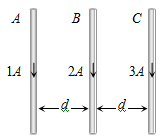
There long straight wires $A, B$ and $C$ are carrying current as shown figure. Then the resultant force on $B$ is directed $.....$
A ray of light incident at an angle \theta on a refracting face of a prism emerges from the other face normally. If the angle of the prism is $5^\circ$ and the prism is made of a material of refractive index $1.5,$ the angle of incidence is :
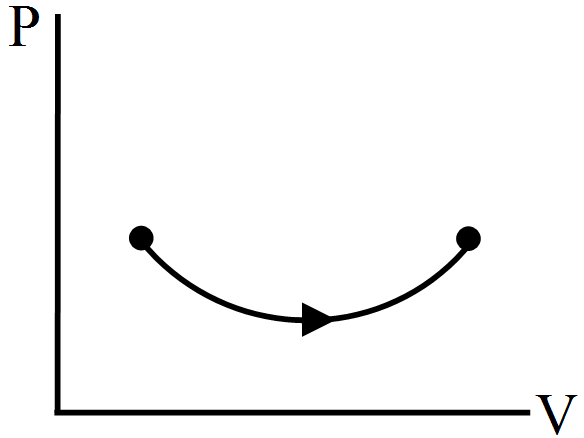
Consider the process on a system shown in figure. During the process, the work done by the system:
  1. Continuously increases.
  2. Continuously decreases.
  3. First increases then decreases.
  4. First decreases then increases.
Bohr's atom model assumes(a) The nucleus is of infinite mass and is at rest(b) Electrons in a quantized orbit will not radiate energy(c) Mass of electron remains constant(d) All the above conditions


Assertion : Radioactivity of $10^8$ undecayed radioactive nuclei of half life of $50$ days is equal to that of $1.2 \times 10^8$ number of undecayed nuclei of some other material with half life of $60$ days  
Reason : Radioactivity is proportional to half-life.
In a spherical condenser radius of the outer sphere is $R$. The different in the radii of outer and inner sphere in $x$. Its capacity is proportional to
If a photon has velocity $c$ and frequency $n$, then which of following represents its wavelength