-
$\frac{\omega\text{M}}{\text{M}+\text{m}}$
-
$\frac{\omega\text{M}}{\text{M}+\text{2m}}$
-
$\frac{\omega(\text{M}-\text{2m})}{\text{M}+\text{2m}}$
-
$\frac{\omega(\text{M}+\text{2m})}{\text{M}}$
$\frac{\omega\text{M}}{\text{M}+\text{m}}$
$\frac{\omega\text{M}}{\text{M}+\text{2m}}$
$\frac{\omega(\text{M}-\text{2m})}{\text{M}+\text{2m}}$
$\frac{\omega(\text{M}+\text{2m})}{\text{M}}$
Explanation:
No external torque is applied on the ring; therefore, the angular momentum will be conserved.
$\text{I}\omega=\text{I}'\omega'$
$\Rightarrow\omega'=\frac{\text{I}\omega}{\Gamma}\ \dots(\text{i})$
$\text{I}=\text{Mr}^2$
$\text{I}'=\text{Mr}^2+\text{2mr}^2$
On putting these values in equation (i), we get:
$\omega'=\frac{\omega\text{M}}{\text{M}+\text{2m}}$
Generate a complete, print-ready paper with questions like this in minutes — across 16+ boards, with answer keys.
Assertion : X-ray travel with the speed of light.
Reason : X-rays are electromagnetic rays.
|
(a) If both assertion and reason are true and the reason is the correct explanation of the assertion. |
|
(b) If both assertion and reason are true but reason is not the correct explanation of the assertion. |
|
(c) If assertion is true but reason is false. |
|
(d) If the assertion and reason both are false. |
Consider two point charges of equal magnitude and opposite sign separated by a certain distance. The neutral point due to them
|
(a) Does not exist |
|
(b) Will be in mid way between them |
|
(c) Lies on the perpendicular bisector of the line joining the two |
|
(d) Will be closer to the negative charge |
A moving coil galvanometer of resistance 100 is used as an ammeter using a resistance 0.1 The maximum deflection current in the galvanometer is 100A. Find the minimum current in the circuit so that the ammeter shows maximum deflection
|
(a) 100.1 mA |
(b) 1000.1 mA |
(c) 10.01 mA |
(d) 1.01 mA |
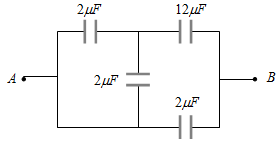
Four capacitors are connected in a circuit as shown in the figure. The effective capacitance in μF between points A and B will be

|
(a) |
(b) 4 |
(c) 5 |
(d) 18 |
A 10 ohm electric heater operates on a 110 V line. Calculate the rate at which it develops heat in watts
|
(a) 1310 W |
(b) 670 W |
(c) 810 W |
(d) 1210 W |
A voltmeter essentially consists of
|
(a) A high resistance, in series with a galvanometer |
|
(b) A low resistance, in series with a galvanometer |
|
(c) A high resistance in parallel with a galvanometer |
|
(d) A low resistance in parallel with a galvanometer |