Question
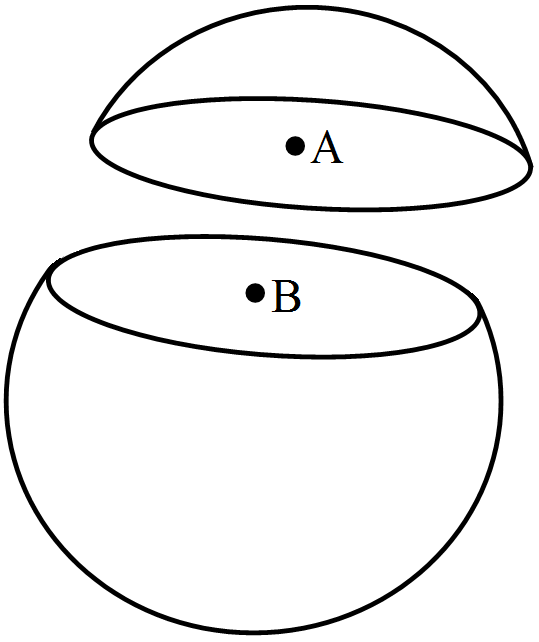
A thin spherical shell having uniform density is cut in two parts by a plane and kept separated as shown in figure (11-E3). The point A is the centre of the plane section of the first part and B is the centre of the plane section of the second part. Show that the gravitational field at A due to the first part is equal in magnitude to the gravitational field at B due to the second part.
Answer

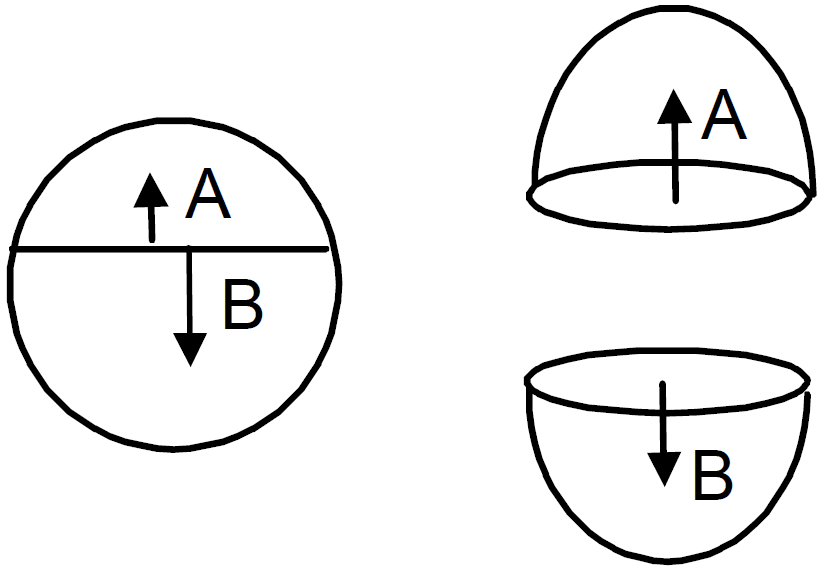
We know in the thin spherical shell of uniform density has gravitational field at its internal point is zero.
At A and B point, field is equal and opposite and cancel each other so Net field is zero.
Hence, EA = EB

Need a full question paper?

Generate a complete, print-ready paper with questions like this in minutes — across 16+ boards, with answer keys.

Start Generating Free

Similar questions

Each side of a square is 90 cm long. At its corners $-2,+3,-4$ and +5 micro coulomb charges are placed respectively. Find the electric potential at the centre of the square.
The magnetic force on a charged particle is always perpendicular to its velocity. Can the magnetic force change the velocity of the particle? Speed of the particle?
Gravitational force or spring force is conservative force - explain.
Explain current sensitivity and voltage sensitivity of galvanometer.
As the wavelength is increased from violet to red, the luminosity:
  1. Continuously increases.
  2. Continuously decreases.
  3. Increases then decreases.
  4. Decreases then increases.
A point source emitting 628 lumen of luminous flux uniformly in all directions is placed at the origin. Calculate the illuminance on a small area placed at (1.0m, 0, 0) in such a way that the normal to the area makes an angle of 37º with the X-axis.
A hydrogen atom contains one proton and one electron. It may be assumed that the electron revolves in a circle of radius 0.53 angstrom (1 angstrom = 10-10m and is abbreviated as A) with the proton at the centre. The hydrogen atom is said to be in the ground state in this case. Find the magnitude of the electric force between the proton and the electron of a hydrogen atom in its ground state.
Let $\vec{\text{a}}=4\vec{\text{i}}+3\vec{\text{j}}$ and $\vec{\text{b}}=3\vec{\text{i}}+4\vec{\text{j}}.$ (a) Find the magnitudes of:

  1. $\vec{\text{a}}$

  2. $\vec{\text{b}}$

  3. $\vec{\text{a}}+\vec{\text{b}}$

  4. $\vec{\text{a}}-\vec{\text{b}}$

Draw equipotential surface due to the following :(i) Any electric dipole(ii) Two identical positive charges separated by some distance.
Write characteristics of electro magnetic waves.