Question
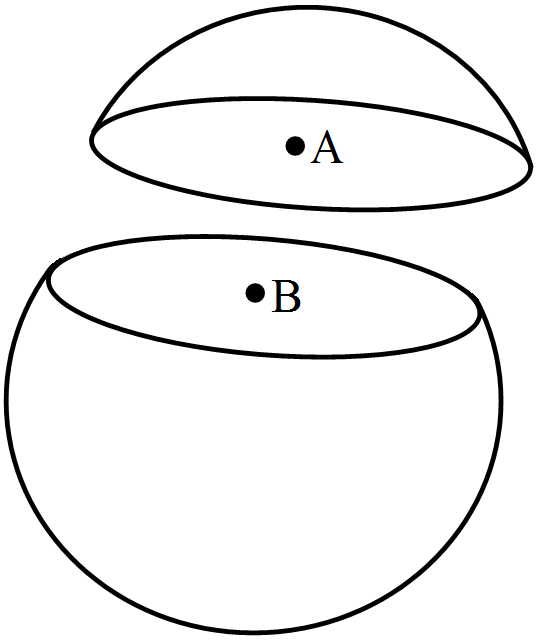
A thin spherical shell having uniform density is cut in two parts by a plane and kept separated as shown in figure (11-E3). The point A is the centre of the plane section of the first part and B is the centre of the plane section of the second part. Show that the gravitational field at A due to the first part is equal in magnitude to the gravitational field at B due to the second part.
Answer

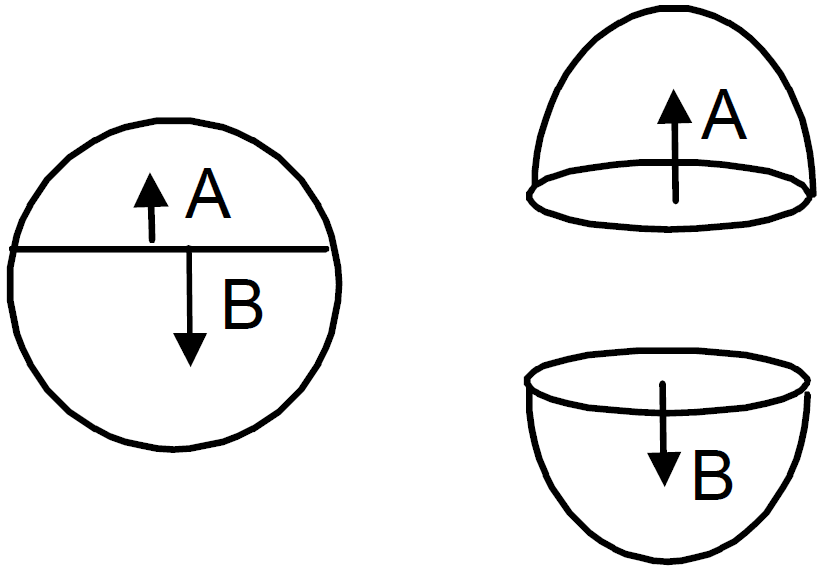
We know in the thin spherical shell of uniform density has gravitational field at its internal point is zero.
At A and B point, field is equal and opposite and cancel each other so Net field is zero.
Hence, $E_A=E_B$

Need a full question paper?

Generate a complete, print-ready paper with questions like this in minutes — across 16+ boards, with answer keys.

Start Generating Free

Similar questions

Figure shows a boy pulling a wagon on a road. List as many forces as you can which are relevant with this figure. Find the pairs of forces connected by Newton's third law of motion.
A cyclist speeding at 18km/ h on a level road takes a sharp circular turn of radius 3m without reducing the speed. The co-efficient of static friction between the tyres and road is 0.1. Will the cyclist slip while taking the turn? Explain.
A piano wire weighing 6.00g and having a length of, 90.0cm emits a fundamental frequency corresponding to the "Middle C" (v = 261.63Hz). Find the tension in the wire.
A car of mass 1000 kg moving with a speed of $30 \mathrm{~ms}^{-1}$ collides with the back of a stationary lorry of mass 9000 kg . (Fig.).Calculate the speed of the vehicles immediately after the collision if they remain jammed together.
A high jumper successfully clears the bar. Is it possible that his centre of mass crossed the bar from below it? Try it with appropriate figures.
Water is escaping from a vessel through a horizontal capillary tube $20cm$ long $0.2mm$ radius at a point $100cm$ below the free surface of water in the vessel. Calculate the rate of flow if coefficient of viscosity of water be $1 \times 10^{-3} Pa-s$.
The speed of sound wave depends on temperature but speed of light waves does not. Why?
The acceleration-time graph for a body is shown in the figure below. Plot the corresponding velocity-time graph.
Suppose you are told that the linear size of everything in the universe has been doubled overnight. Can you test this statement by measuring sizes with a metre stick? Can you test it by using the fact that the speed of light is a universal constant and has not changed? What will happen if all the clocks in the universe also start running at half the speed?
What do you mean by the "phases" of a substance?