Question
A thin spherical shell lying on a rough horizontal surface is hit by a cue in such a way that the line of action passes through the centre of the shell. As a result, the shell starts moving with a linear speed v without any initial angular velocity. Find the linear speed of the shell after it starts pure rolling on the surface.
Answer


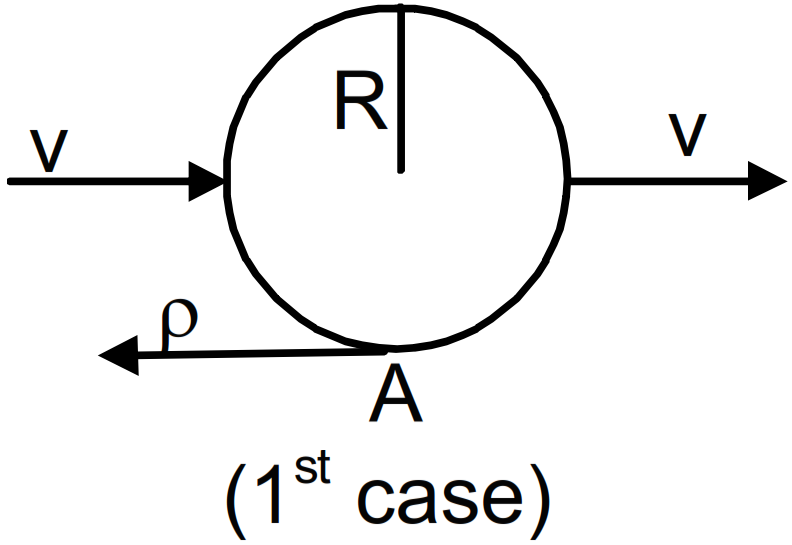
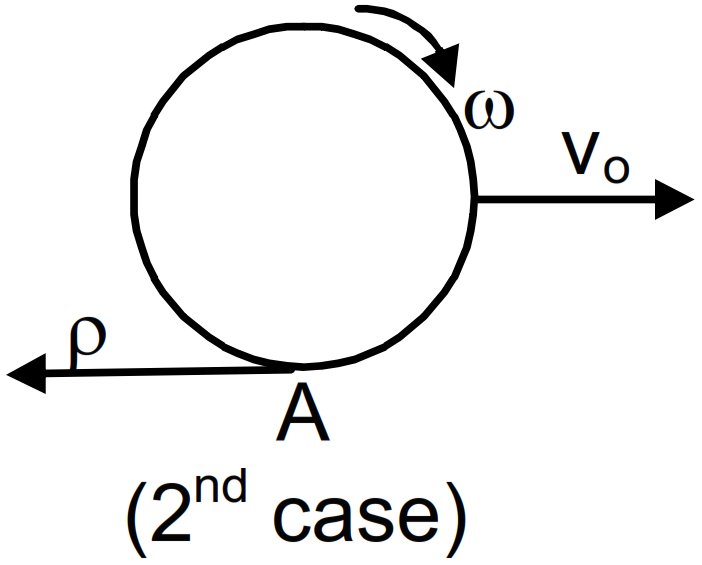
The shell will move with a velocity nearly equal to v due to this motion a frictional force well act in the background direction, for which after some time the shell attains a pure rolling. If we consider moment about A, then it will be zero.

Therefore, Net angular momentum about A before pure rolling = net angular momentum after pure rolling.
Now, angular momentum before pure rolling about A = M(V × R) and angular momentum after pure rolling:
$\Big(\frac{2}{3}\Big)\text{MR}^2\times\Big(\frac{\text{V}_0}{\text{R}}\Big)+\text{MV}_0\text{R}$
($V_0$ = velocity after pure rolling)
$\Rightarrow\text{MVR}=\frac{2}3{}\text{MV}_0\text{R}+\text{MV}_0\text{R}$
$\Rightarrow\Big(\frac{5}{3}\Big)\text{V}_0=\text{V}$
$\Rightarrow\text{V}_0=\frac{3\text{V}}{5}$

Need a full question paper?

Generate a complete, print-ready paper with questions like this in minutes — across 16+ boards, with answer keys.

Start Generating Free

Similar questions

Three simple harmonic motions of equal amplitudes A and equal time periods in the same direction combine. The phase of the second motion is 60° ahead of the first and the phase of the third motion is 60° ahead of the second. Find the amplitude of the resultant motion.
The earth-moon distance is about $60$ earth radius. What will be the diameter of the earth (approximately in degrees) as seen from the moon?
A free atom of iron emits $\text{K}_\alpha$ X-rays of energy 6.4keV. Calculate the recoil kinetic energy of the atom. Mass of an iron atom = $9.3 \times 10^{-26}kg$.
Show that when a particle is moving in S.H.M. its velocity at a distance $\frac{\sqrt{3}}{2}$ of its amplitude from the central position is half its velocity in central position.
Figure shows a smooth track, a part of which is a circle of radius R. A block of mass m is pushed against a spring of spring constant k fixed at the left end and is then released. Find the initial compression of the spring so that the block presses the track with a force mg when it reaches the point P, where the radius of the track is horizontal.
A current-carrying circular coil of 100 turns and radius 5.0cm produces a magnetic field of $6.0 \times 10^{-5}T$ at its centre. Find the value of the current.
Explain the pressure exerted by an ideal gas and also find the average kinetic energy per molecule of the gas.
Find the difference in temperature across the surfaces of an iron plate 5 cm thick, through $100 \mathrm{sq} . \mathrm{m}$ of which heat flows at the rate of $9.6 \times 10^5 \mathrm{~J} / \mathrm{s}$. [Take $\mathrm{K}=96 \mathrm{Wm}^{-1} \mathrm{~K}^{-1}$]
A circular loop of radius 20cm carries a current of 10A. An electron crosses the plane of the loop with a speed of $2.0 \times 10^6m/s$. The direction of motion makes an angle of 30° with the axis of the circle and passes through its centre. Find the magnitude of the magnetic force on the electron at the instant it crosses the plane.
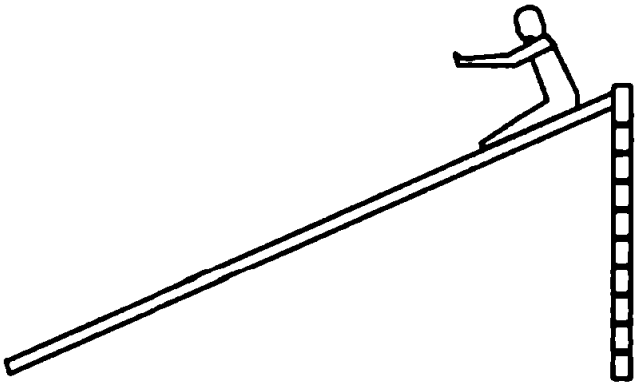
In a children's park, there is a slide which has a total length of 10m and a height of 8.0m (figure). Vertical ladder are provided to reach the top. A boy weighing 200N climbs up the ladder to the top of the slide and slides down to the ground. The average friction offered by the slide is three tenth of his weight. Find
  1. The work done by the ladder on the boy as he goes up.
  2. The work done by the slide on the boy as he comes down. Neglect any work done by forces inside the body of the boy.