Question
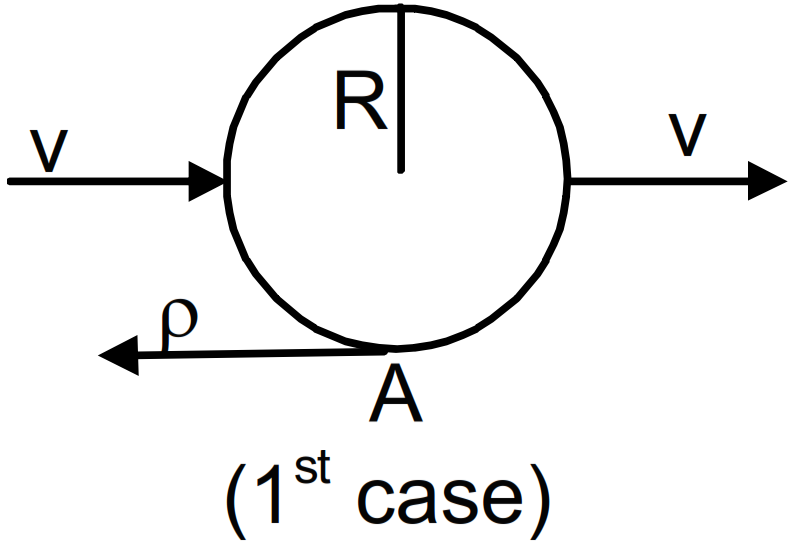
A thin spherical shell lying on a rough horizontal surface is hit by a cue in such a way that the line of action passes through the centre of the shell. As a result, the shell starts moving with a linear speed v without any initial angular velocity. Find the linear speed of the shell after it starts pure rolling on the surface.

Answer


The shell will move with a velocity nearly equal to v due to this motion a frictional force well act in the background direction, for which after some time the shell attains a pure rolling. If we consider moment about A, then it will be zero.
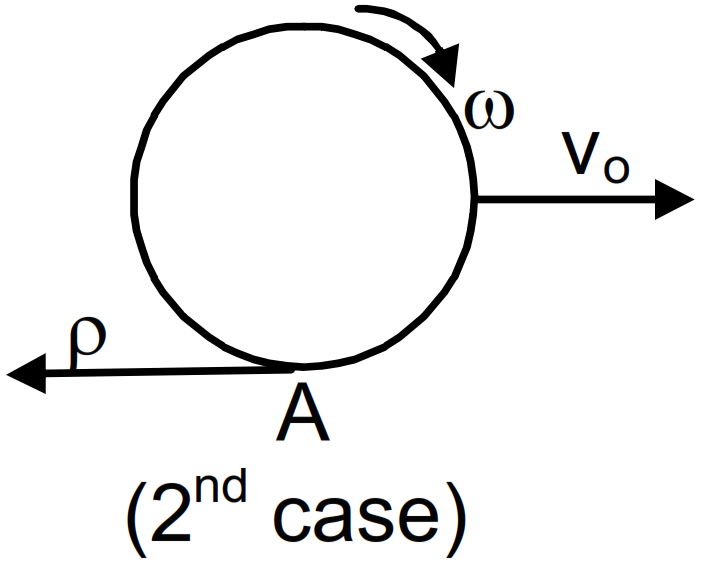
Therefore, Net angular momentum about A before pure rolling = net angular momentum after pure rolling.

Now, angular momentum before pure rolling about A = M(V × R) and angular momentum after pure rolling:

$\Big(\frac{2}{3}\Big)\text{MR}^2\times\Big(\frac{\text{V}_0}{\text{R}}\Big)+\text{MV}_0\text{R}$

(V0 = velocity after pure rolling)

$\Rightarrow\text{MVR}=\frac{2}3{}\text{MV}_0\text{R}+\text{MV}_0\text{R}$

$\Rightarrow\Big(\frac{5}{3}\Big)\text{V}_0=\text{V}$

$\Rightarrow\text{V}_0=\frac{3\text{V}}{5}$
Need a full question paper?

Generate a complete, print-ready paper with questions like this in minutes — across 16+ boards, with answer keys.

Start Generating Free

Similar questions

What is the energy of a hydrogen atom in the first excited state if the potential energy is taken to be zero in the ground state?
How electromagnetic waves are produced? What is the source of the energy accompanied by any propagating electromagnetic wave?
(i) In far switches of household electrical appliances
(ii) In medical diagnosis
The diameter of the sun is 1.4 × 10⁹m and its distance from the earth is 1.5 × 10¹¹m. Find the radius of the image of the sun formed by a lens of focal length 20cm.
If one of the two electrons of a H2 molecule is removed, we get a hydrogen molecular ion $\text{H}^+_2​.$ In the ground state of an $\text{H}^+_2​,$ the two protons are separated by roughly 1.5 Å, and the electron is roughly 1 Å from each proton. Determine the potential energy of the system. Specify your choice of the zero of potential energy.
Answer the following:
  1. Name the em waves which are produced during radioactive decay of a nucleus. Write their frequency range.
  2. Welders wear special glass goggles while working. Why? Explain.
  3. Why are infrared waves often called as heat waves? Give their one application.
  1. Draw a plot showing the variation of photoelectric current with collector potential for different frequencies but same intensity of incident radiation.
  2. Use Einstein’s photoelectric equation to explain the observations from this graph.
  3. What change will you observe if intensity of incident radiation is changed but the frequency remains the same?
The conductivity of a pure semiconductor is roughly proportional to $\text{T}^\frac{3}{2}\text{e}^{\frac{-\Delta\text{E}}{2\text{kT}}}$ where $\Delta\text{E}$ is the band gap. The band gap for germanium is 0.74eV at 4K and 0.67eV at 300K. By what factor does the conductivity of pure germanium increase as the temperature is raised from 4K to 300K?
Prove that a closed equipotential surface with no charge within itself must enclose an equipotential volume.
By defining conduction current, explain why Maxwell propounded the idea of displacement current?