MCQ
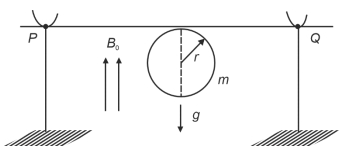
A thin stiff insulated metal wire is bent into a circular loop with its two ends extending tangentially from the same point of the loop. The wire loop has mass $m$ and radius $r$ and it is in a uniform vertical magnetic field $B_0$, as shown in the figure. Initially, it hangs vertically downwards, because of acceleration due to gravity $g$, on two conducting supports at $P$ and $Q$. When a current $/$ is passed through the loop, the loop turns about the line $P Q$ by an angle $\theta$ given by
  • A
    $\tan \theta=\pi r I B_0 /(m g)$
  • B
    $\tan \theta=2 \pi r I B_0 /(m g)$
  • C
    $\tan \theta=\pi r I B_0 /(2 m g)$
  • D
     $\tan \theta=m g /\left(\pi r / B_0\right)$
Answer

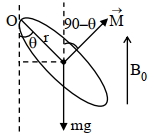
Let loop makes angle $\theta$ with vertical.

$\text { in equilibrium } \tau_{\text {net }}=0$

$\tau_0= MB \sin (90-\theta)- mg \cdot r \sin \theta=0$

$\text { I. } \pi r ^2 \cdot B _0 \cos \theta= mg r \cdot \sin \theta$

$\tan \theta=\frac{\pi rIB }{ mg }$

Need a full question paper?

Generate a complete, print-ready paper with questions like this in minutes — across 16+ boards, with answer keys.

Start Generating Free

Similar questions

Select the correct statement
Adiabatic modulus of elasticity of a gas is $2.1 \times 10^5 \mathrm{~N} / \mathrm{m}^2$. What will be its isothermal modulus of elasticity $\left(\frac{C_p}{C_v}=1.4\right)$
Coatings used on raincoat are waterproof because
A wire $c d$ of length $l$ and mass $m$ is sliding without friction on conducting rails $a x$ and by as shown. The vertical rails are connected to each other with a resistance $R$ between $a$ and $b$. A uniform magnetic field $B$ is applied perpendicular to the plane abcd such that $c d$ moves with a constant velocity of
Image
In a thermodynamic system working substance is ideal gas, its internal energy is in the form of
The minimum frequency $v$ of continuous $X$-rays is related to the applied potential difference $V$ as
During capillary rise of a liquid in a capillary tube, the surface of contact that remains constant is of
At two places $A$ and $B$ using vibration magnetometer, a magnet vibrates in a horizontal plane and its respective periodic time are $2$ sec and $3 \mathrm{sec}$ and at these places the earth's horizontal components are $H$ and $H$ respectively. Then the ratio between $H$ and $H$ will be
The magnitude of a given vector with end points $(4,-4,0)$ and $(-$ $2,-2,0)$ must be
The maximum current that can be measured by a galvanometer of resistance $40 \,\Omega$ is $10\, mA$. It is converted into a voltmeter that can read upto $50\, V$. The resistance to be connected in series with the galvanometer is ... (in $ohm$)