Question
A torsional pendulum consists of a solid disc connected to a thin wire$\Big(\alpha=2.4\times10^{-5}\ ^\circ\text{C}^{-1}\Big)$at its centre. Find the percentage change in the time period between peak winter (5°C) and peak summer (45°C).

Answer

Let the initial m.I. at 0°C be $\text{I}_0$

$\text{T}=2\pi\sqrt\frac{\text{I}}{\text{K}}$

$\text{I}=\text{I}_0(1+2\alpha\Delta\theta)$ (from above question)

At 5°C, $\text{T}_1=2\pi\sqrt\frac{\text{I}_0(1+2\alpha\Delta\theta)}{\text{K}}$

$=2\pi\sqrt\frac{\text{I}_0(1+2\alpha\Delta5)}{\text{k}}$

$=2\pi\sqrt\frac{\text{I}_0(1+10\alpha)}{\text{K}}$

At 45°C, $\text{T}_2=2\pi\sqrt\frac{\text{I}_0(1+2\alpha45)}{\text{K}}$

$2\pi\sqrt\frac{\text{I}_0(1+90\alpha)}{\text{K}}$

$\frac{\text{T}_2}{\text{T}_1}=\sqrt\frac{1+90\alpha}{1+10\alpha}$

$=\sqrt\frac{1+90\times2.4\times10^{-5}}{1+10\times2.4\times10^{-5}}\sqrt\frac{1.00216}{1.00024}$

% change $=\Big(\frac{\text{T}_2}{\text{T}_1}-1\Big)\times100$

$=0.0959\%=9.6\times10^{-2}\%$

Need a full question paper?

Generate a complete, print-ready paper with questions like this in minutes — across 16+ boards, with answer keys.
Start Generating Free

Similar questions

If a number of little droplets of water of surface tension S, all of the same radius r combine to form a single drop of radius R and the energy released is converted into K.E. Find the velocity acquired by the bigger drop. If the energy released is converted into heat, find the rise in temperature.
Calculate the center of mass of a uniform thin rod.
A particle of mass 1g and charge 2.5 × 10-4C is released from rest in an electric field of 1.2 × 104NC-1.
  1. Find the electric force and the force of gravity acting on this particle. Can one of these forces be neglected in comparison with the other for approximate analysis?
  2. How long will it take for the particle to travel a distance of 40cm?
  3. What will be the speed of the particle after travelling this distance?
  4. How much is the work done by the electric force on the particle during this period?
In an experimental set up, the density of a small sphere is to be determined. The diameter of the small sphere is measured with the help of a screw gauge, whose pitch is 0.4mm and there are 50 divisions on the circular scale. The reading on the main scale is 2.5mm and that on the circular scale is 20 divisions. If the measured mass of the sphere has a relative error of 2%, find the relative percentage error in density.
The frequency of vibration of a string depends on the length L between the nodes, the tension F in the string and its mass per unit length m. Guess the expression for its frequency from dimensional analysis.
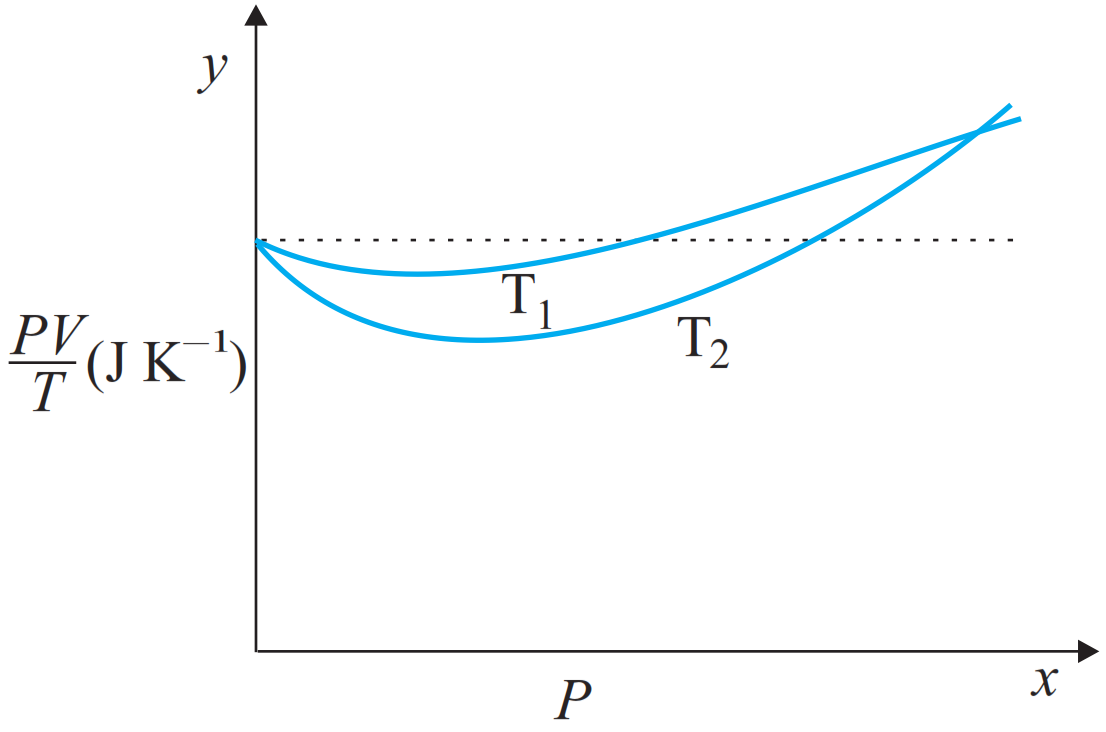
Shows plot of $\frac{\text{PV}}{\text{T}}$ versus P for 1.00 × 10⁻³kg of oxygen gas at two different temperatures:

What is the value of $\frac{\text{PV}}{\text{T}}$ where the curves meet on the y-axis?

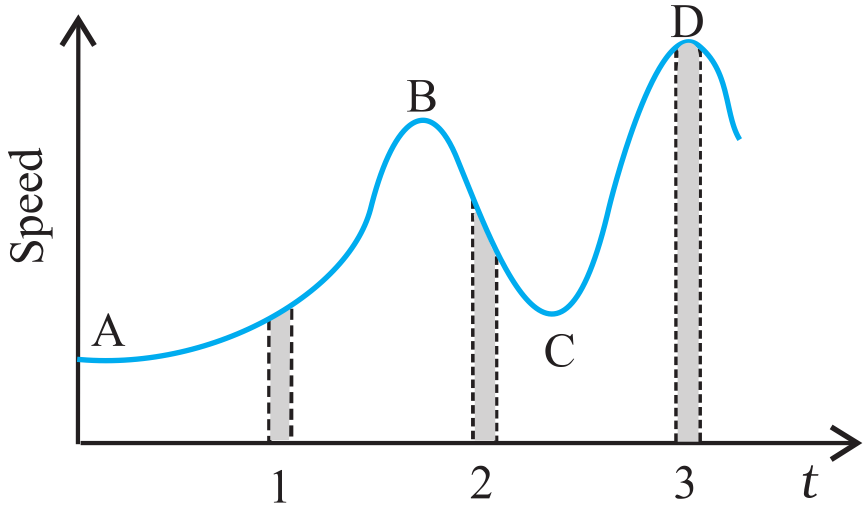
Gives a speed-time graph of a particle in motion along a constant direction. Three equal intervals of time are shown. In which interval is the average acceleration greatest in magnitude? In which interval is the average speed greatest? Choosing the positive direction as the constant direction of motion, give the signs of v and a in the three intervals. What are the accelerations at the points A, B, C and D?

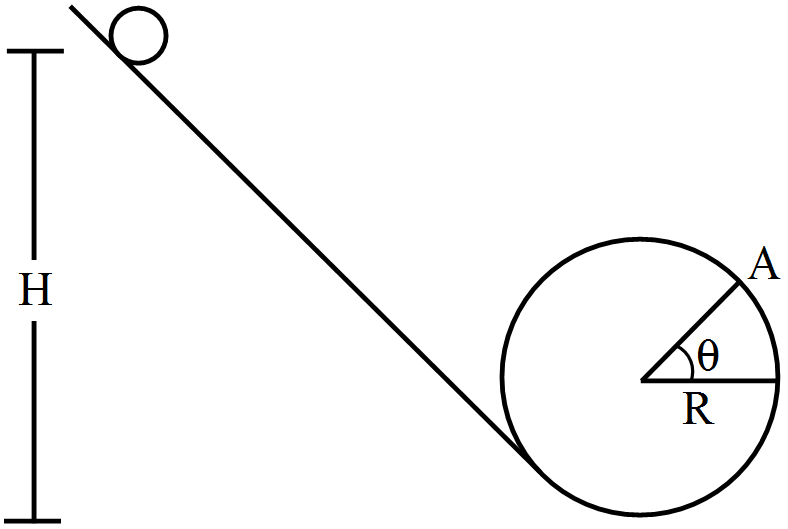
Figure shows a small spherical ball of mass m rolling down the loop track. The ball is released on the linear portion at a vertical height H from the lowest point. The circular part shown has a radius R.
  1. Find the kinetic energy of the ball when it is at a point A where the radius makes an angle $\theta$ with the horizontal.
  2. Find the radial and the tangential accelerations of the centre when the ball is at A.
  3. Find the normal force and the frictional force acting on the ball if H = 60cm, R = 10cm, $\theta=0 $ and m = 70g.

To determine acceleration due to gravity, the time of 20 oscillations of a simple pendulum of length 100cm was observed to be 40s. Calculate the value of g and maximum percentage error in the measured value of g.
Show that for a particle in linear S.H.M., the average K.E. over a period of oscillation equals the average P.E. over the same period.