MCQ
A total solar eclipse is observed from the earth. At the same time an observer on the moon view's the earth. She is most likely to see ( $E$ denotes the earth)
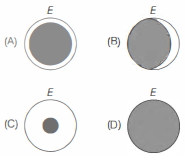
- A$A$
- B$B$
- ✓$C$
- D$D$
Size of moon is very small compared to that of earth also, moon is much nearer to earth in comparison to sun.
Hence, shadow of moon covers only a small part of earth as shown in the figure given below.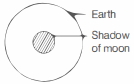
Generate a complete, print-ready paper with questions like this in minutes — across 16+ boards, with answer keys.
(image)
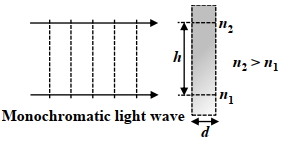
($A$) It will deflect up by an angle $\tan ^{-1}\left[\frac{\left(n_2^2-n_1^2\right) d}{2 h}\right]$
($B$) It will deflect up by an angle $\tan ^{-1}\left[\frac{\left(n_2-n_1\right) d}{h}\right]$
($C$) It will not deflect.
($D$) The deflection angle depends only on $\left(n_2-n_1\right)$ and not on the individual values of $n_1$ and $n_2$.