MCQ
A train moves from rest with a uniform acceleration $a$ . Attaining a maximum speed $v$ it  starts moving with uniform retardation $a$ . Assuming $s$ = total distance covered in the  unidirectional motion of the train, its total time of journey and maximum speed are  (respectively).
  • A
    $\sqrt {\frac{s}{a}},\sqrt {as}$
  • $2 \sqrt {\frac{s}{a}},\sqrt {as}$
  • C
    $\sqrt {\frac{2s}{a}},\sqrt {as}$
  • D
    $\frac{1}{2} \sqrt {\frac{s}{a}},\sqrt {\frac{as}{2}}$
Answer

Correct option: B.
$2 \sqrt {\frac{s}{a}},\sqrt {as}$
b

Need a full question paper?

Generate a complete, print-ready paper with questions like this in minutes — across 16+ boards, with answer keys.

Start Generating Free

Similar questions

A bus appears to go with a speed of $25 \,km / hr$ to a car driver, driving at the rate $7 \,km / hr$ northwards. If the bus actually travels in east direction, its speed is ......... $km / h$
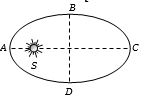
A planet is revolving around the sun as shown in elliptical path  the orbital velocity of the planet will be minimum at
Which of the following statements is correct
Particles $A$ and $B$ are moving with constant velocities along $x$ and $y$ axis respectively, the graph of separation between them with time is
A boy ties a stone of mass $100 \,g$ to the end of a $2$ $m$ long string and whirls it around in a horizontal plane. The string can withstand the maximum tension of $80 \,N$. If the maximum speed with which the stone can revolve is $\frac{ K }{\pi} rev$. / $min$. The value of $K$ is (Assume the string is massless and unstretchable)
A body cools from $80^{\circ}\,C$ to $60^{\circ}\,C$ in $5$ minutes. The temperature of the surrounding is $20^{\circ} C$. The time it takes to cool from $60^{\circ}\,C$ to $40^{\circ}\,C$ is........... $s$
The displacement of the interfering light waves are ${y_1} = 4\sin \omega \,t$ and ${y_2} = 3\sin \left( {\omega \,t + \frac{\pi }{2}} \right)$. What is the amplitude of the resultant wave
An unloaded bus can be stopped by applying brakes on straight road after covering a distance $x$. Suppose, the passenger add $50 \%$ of its weight as the load and the braking force remains unchanged, how far will the bus go after the application of the brakes? (Velocity of bus in both case is same)
A projectile is thrown upward with a velocity $v_0$ at an angle $\alpha$ to the horizontal. The change in velocity of the projectile when it strikes the same horizontal plane is
The pressure of an ideal gas is written as $\text{p}=\frac{2\text{E}}{3\text{v}}.$ Here E refers to:
  1. Translational kinetic energy.
  2. Rotational kinetic energy.
  3. Vibrational kinetic energy.
  4. Total kinetic energy.