Question
A train start moving from rest and its speed increases with uniform acceleration for 10 sec . At the end of 5 sec . its speed become $54 km /$ hour.
(a) Find the acceleration of the train.
(b) What will be its speed after 10 sec ?
(c) How much distance will the train travel in 10 sec?
(d) How much distance did the train cover in the seventh and tenth second respectively?
Answer

(A) speed after $5 sec .=54 km / hr$.
$=54 \times \frac{5}{18} m / s=15 m / s$
At rest $u =0, v =15 m / s , t =5 sec , a =$ ?
From the first equation of motion,
$v=u+at$
$\begin{array}{ll}
\therefore \quad a & =\frac{v-u}{t}=\frac{15-0}{5} \\
& a=3 m / s^2
\end{array}$
(b) Velocity after $10 sec . v = u +$ at
$=0+3 \times 10=30 m / s$
(c) Distance
$\begin{aligned}
s & =u t+\frac{1}{2} at^2 \\
& =0 \times 10+\frac{1}{2} \times 3 \times 10 \times 10 \\
& =150 \text { meter }
\end{aligned}$
(d) Distance covered in nth second
$s_{n}=u+\frac{1}{2} a(2 n-1)$
Therefore distance in 7th second
$\begin{aligned}
s_7 & =0+\frac{1}{2} \times 3(2 \times 7-1) \\
& =\frac{39}{20}=19.5 \text { meter }
\end{aligned}$
Distance in 10th sec.
$\begin{aligned}
s_{10} & =0+\frac{1}{2} \times 3 \times(2 \times 10-1) \\
& =\frac{57}{2}=28.5 \text { meter }
\end{aligned}$

Need a full question paper?

Generate a complete, print-ready paper with questions like this in minutes — across 16+ boards, with answer keys.

Start Generating Free

Similar questions

Can two equipotential surfaces cut each other?
State Kepler's laws of planetary motion and deduce Newton's Law of gravitation from them.
The ratio of radius of two wires of the same metal is 2 : 1. If they are pulled by applying equal force, what will be the ratio of stresses?
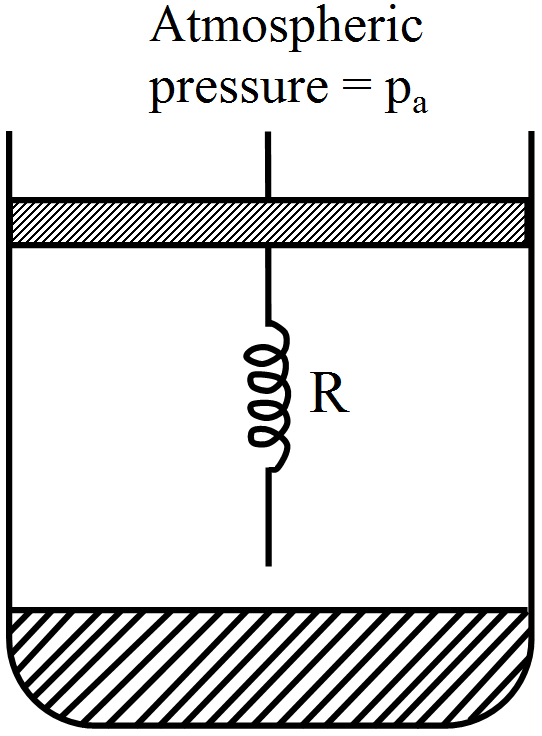
Consider one mole of perfect gas in a cylinder of unit cross-section with a piston attached $($figure$)$. A spring $($spring constant $k)$ is attached $($unstretched length $L)$ to the piston and to the bottom of the cylinder. Initially, the spring is unstretched and the gas is in equilibrium. A certain amount of heat $Q$ is supplied to the gas causing an increase of volume from $V_0$ to $V_1$.
  1. What is the initial pressure of the system?
  2. What is the final pressure of the system?
  3. Using the first law of thermodynamics, write down a relation between $Q, P_a, V, V_0$, and $k$.
Two simple harmonic motions are represented by the following equations:$\text{y}_1=10\sin\frac{\pi}{4}(12\text{t}+1)$
and $\text{y}_2=5(\sin3\pi\text{t}+\sqrt{3}\cos\pi\text{t}).$ What is the ratio of their amplitudes?
The current in a solenoid of 240 turns, having a length of 12cm and a radius of 2cm, changes at a rate of 0.8A/s. Find the emf induced in it.
$2g$ of hydrogen is sealed in a vessel of volume $0.02m^3$​​​​​​​ and is maintained at $300K$. Calculate the pressure in the vessel.
A ball of mass $0.50kg$ moving at a speed of 5.0m/s collides with another ball of mass $1.0kg$. After the collision the balls stick together and remain motionless. What was the velocity of the $1.0kg$ block before the collision?
An electron and a positron moving at small speeds collide and annihilate each other. Find the energy of the resulting gamma photon.
A 100W bulb has tungsten filament of total length 1.0m and radius $4 \times 10^{-5}m$. The emissivity of the filament is 0.8 and $\sigma=6.0\times10^{-8}\text{Wm}^{-2}\text{K}^4.$ Calculate the temperature of the filament when the bulb is operating at correct wattage.