MCQ
A transformer is based on the principle of
  • Mutual inductance
  • B
    Self inductance
  • C
    Ampere's law
  • D
    Lenz's law

Answer

Correct option: A.
Mutual inductance
a
(a) A transformer has got one primary coil, the change of current in which produces an induced emf in the secondary coil. Hence it is based on the principle of mutual induction.

Need a full question paper?

Generate a complete, print-ready paper with questions like this in minutes — across 16+ boards, with answer keys.
Start Generating Free

Similar questions

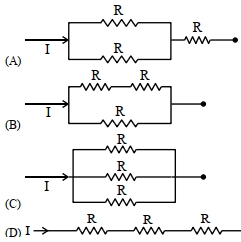
Different combination of $3$ resistors of equal resistance $R$ are shown in the figures.
The increasing order for power dissipation is:
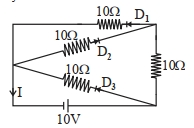
In the given circuit, the current $(I)$ through the battery will be $..........\,A$
A disc is rotating with angular velocity $\vec{\omega}$. A force $\vec{F}$ acts at a point whose position vector with respect to the axis of rotation is $\vec{r}$. The power associated with torque due to the force is given by ..........
The kinetic energy of an electron which is accelerated through a potential of $100$ volts is
Switch $S$ is closed at $t = 0$, in the circuit shown. The change in flux in the inductor $(L=500\, mH)$ from $t = 0$ to an instant when it reaches steady state is ......$wb$
If lateral magnification is $-2$ for virtual object for a spherical mirror then 
 A charged particle (electron or proton) is introduced at the origin $(x=0, y=0, z=0)$ with a given initial velocity $\overrightarrow{\mathrm{v}}$. A uniform electric field $\overrightarrow{\mathrm{E}}$ and magnetic field $\vec{B}$ are given in columns $1,2$ and $3$ , respectively. The quantities $E_0, B_0$ are positive in magnitude.

column $I$

column $II$ column $III$
$(I)$ Electron with $\overrightarrow{\mathrm{v}}=2 \frac{\mathrm{E}_0}{\mathrm{~B}_0} \hat{\mathrm{x}}$ $(i)$ $\overrightarrow{\mathrm{E}}=\mathrm{E}_0^2 \hat{\mathrm{Z}}$ $(P)$ $\overrightarrow{\mathrm{B}}=-\mathrm{B}_0 \hat{\mathrm{x}}$
$(II)$ Electron with $\overrightarrow{\mathrm{v}}=\frac{\mathrm{E}_0}{\mathrm{~B}_0} \hat{\mathrm{y}}$ $(ii)$ $\overrightarrow{\mathrm{E}}=-\mathrm{E}_0 \hat{\mathrm{y}}$ $(Q)$ $\overrightarrow{\mathrm{B}}=\mathrm{B}_0 \hat{\mathrm{x}}$
$(III)$ Proton with $\overrightarrow{\mathrm{v}}=0$ $(iii)$ $\overrightarrow{\mathrm{E}}=-\mathrm{E}_0 \hat{\mathrm{x}}$ $(R)$ $\overrightarrow{\mathrm{B}}=\mathrm{B}_0 \hat{\mathrm{y}}$
$(IV)$ Proton with $\overrightarrow{\mathrm{v}}=2 \frac{\mathrm{E}_0}{\mathrm{~B}_0} \hat{\mathrm{x}}$ $(iv)$ $\overrightarrow{\mathrm{E}}=\mathrm{E}_0 \hat{\mathrm{x}}$ $(S)$ $\overrightarrow{\mathrm{B}}=\mathrm{B}_0 \hat{\mathrm{z}}$

($1$) In which case will the particle move in a straight line with constant velocity?

$[A] (II) (iii) (S)$    $[B] (IV) (i) (S)$   $[C] (III) (ii) (R)$   $[D] (III) (iii) (P)$

($2$) In which case will the particle describe a helical path with axis along the positive $z$ direction?

$[A] (II) (ii) (R)$   $[B] (IV) (ii) (R)$  $[C] (IV) (i) (S)$   $[D] (III) (iii)(P)$

($3$)  In which case would be particle move in a straight line along the negative direction of y-axis (i.e., more along $-\hat{y}$ )?

$[A] (IV) (ii) (S)$   $[B] (III) (ii) (P)$   $[C]$ (II) (iii) $(Q)$   $[D] (III) (ii) (R)$

Assertion : Two concentric charged shells are given. The potential difference between the shells depends on charge of inner shell.

Reason : Potential due to charge of outer shell remains same at every point inside the sphere.

After passing through a polariser a linearly polarised light of intensity $I$ is incident on an analyser making an angle of $30^{\circ}$ with that of the polariser. The intensity of light emitted from the analyser will be
The metallic surface is illuminated with monochromatic light of wavelength $\lambda $ and stopping potential for photoelectric current is $5V_0$. When the same metallic surface is illuminated with a light of wavelength $2\lambda $ , the stopping potentials is $V_0$. What is the threshold wavelength for the surface ?