Question
A transverse harmonic wave on a string is described by
$\text{y}(\text{x, t})=3.0\sin\big(36\text{t}+0.018\text{x}+\frac{\pi}{4}\big)$
where x and y are in cm and t in s. The positive direction of x is from left to right.
What are its amplitude and frequency?
Answer

3cm; 5.73Hz
Explanation:
Given,
$\text{y}(\text{x, t})=3\sin\big(36\text{t}+0.018\text{x}+\frac{\pi}{4}\big)$
Amplitude of the wave, a = 3cm
Frequency of the wave $\text{v}=\frac{\omega}{2\pi}=\frac{36}{2\pi}=5.7\text{hz}$

Need a full question paper?

Generate a complete, print-ready paper with questions like this in minutes — across 16+ boards, with answer keys.

Start Generating Free

Similar questions

Write the factors affecting surface tension?
Explain why
Hydrostatic pressure is a scalar quantity even though pressure is force divided by area.
Consider two particles A and B having equal charges and placed at some distance. The particle A is slightly displaced towards B. Does the force on B increase as soon as the particle A is displaced? Does the force on the particle A increase as soon as it is displaced?
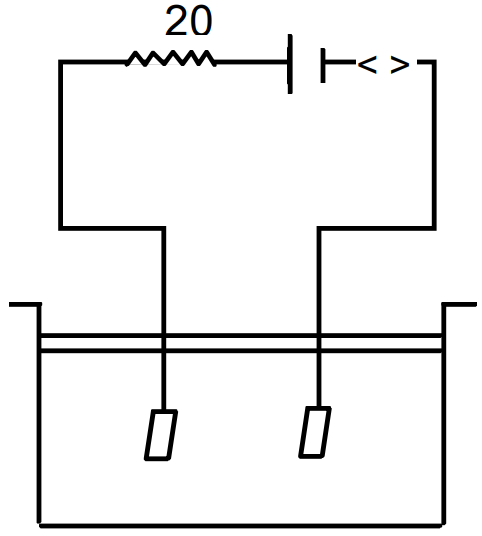
Figure shows an electrolyte of AgCl through which a current is passed. It is observed that 2.68g of silver is deposited in 10 minutes on the cathode. Find the heat developed in the $20\Omega$ resistor during this period. Atomic weight of silver is 107.9g/mole.

A body starts from rest and moves along a straight line. It has uniformly accelerated motion upto time t1. During the interval t2 - t1 it moves with uniform velocity. After time t2 its motion is retarded, and it comes to rest at time t3. Draw the velocity-time graph.
A steel rod of length 1m rests on a smooth horizontal base. If it is heated from 0°C to 100°C, what is the longitudinal strain developed?
A person of mass 50kg stands on a weighing scale on a lift. If the lift is descending with a downward acceleration of 9m s–2, what would be the reading of the weighing scale? (g = 10m s–2)
If the kinetic energy of a light and heavy body is equal, then whose momentum is less?
A curve is represented by $\text{y}=\sin\text{x}.$ If x is changed from $\frac{\pi}{3}$ to $\frac{\pi}{3}+\frac{\pi}{100},$ find approximately the change in y.
Three process $A, B, C$ of expansion of a gas from initial volume $V_1$ to final volume $V_2$ are shown in the figure tell which of these change is isothermal, isobaric and adiabatic?