Question
A transverse harmonic wave on a string is described by
$
y(x, t)=3.0 \sin \left(36 t+0.018 x+\frac{\pi}{4}\right)
$
where $x$ and $y$ are in cm and $t$ in s. The positive direction of $x$ is from left to right.
(a) Is this a travelling wave or a stationary wave?
If it is travelling, what are the speed and direction of its propagation?
(b) What are its amplitude and frequency?
(c) What is the initial phase at the origin?
(d) What is the least distance between two successive crests in the wave?
Answer

The given equation is transverse frquency
$y(x, t)=3.0 \sin \left(36 t+0.018 x+\frac{\pi}{4}\right)$$\quad\ldots$(1)
Standard equation of progressive wave
$y(x, t) =a \sin \left(\frac{2 \pi}{\lambda}(v t-x)+\phi\right) $
$=a \sin \left(\frac{2 \pi}{T} t-\frac{2 \pi}{\lambda} x+\phi\right)$$\quad$$\quad$$\left[\because \frac{1}{T}=\frac{ v }{\lambda}\right]$$\quad\ldots$(2)
(a) By comparing equation (1) with equation (2)
$\frac{2 \pi}{T}=36$
or $\quad \frac{-2 \pi}{\lambda}=0.018$
or$\quad$$\lambda=\frac{-2 \pi}{0.018}\quad\ldots(3)$
$2 \pi n=36$$\quad\ldots$(4)
Multiply equation (3) and equation (4)
$2 \pi n \lambda=\frac{-2 \pi \times 36}{0.018}$
or $\quad n \lambda=\frac{-36 \times 1000}{18}=-2000 cm / s$
Velocity $(v)=-2000 cm / s =-20 m / s$
Here Negative sign represent the wave propagate in right to left.
(b) Given : $\text { speed } =20 m / s $
$a =3.0 cm=3.0 \times 10^{-2} m $
$\frac{2 \pi}{T} =36 $
$\frac{1}{T} =\frac{36}{2 \pi}=\frac{18}{\pi} $
$\text { frequency } n =\frac{18}{3.14}=5.73 Hz$
(c) Phase angle $(\phi)=\frac{\pi}{4}$ Radian
(d) Distance minimum between two consecutive crests wave length $=\lambda$
$=\frac{2 \pi}{0.018} $
$=\frac{2 \times 3.14}{0.018}=348.9 cm $
$\simeq 349 cm $
$\simeq \frac{349}{100} m=3.49 m

$
$\simeq 3.5 m$

Need a full question paper?

Generate a complete, print-ready paper with questions like this in minutes — across 16+ boards, with answer keys.

Start Generating Free

Similar questions

An LR circuit has L = 1.0H and $\text{R}=20\Omega.$ It is connected across an emf of 2.0V at t = 0. Find $\frac{\text{di}}{\text{dt}}$ at:
  1. t = 100ms
  2. t = 200ms
  3. t = 1.0s
Particles of masses 1g, 2g, 3g, ........, 100g are kept at the marks 1cm, 2cm, 3cm, ........, 100cm respectively on a metre scale. Find the moment of inertia of the system of particles about a perpendicular bisector of the metre scale.
Define escape speed and derive the expression for escape velocity on earth's surface.
A threaded rod with 12turns/ cm and diameter 1.18cm is mounted horizontally. A bar with a threaded hole to match the rod is screwed onto the rod. The bar spins at 216rev/ min. How long will it take for the bar to move 1.50cm along the rod?
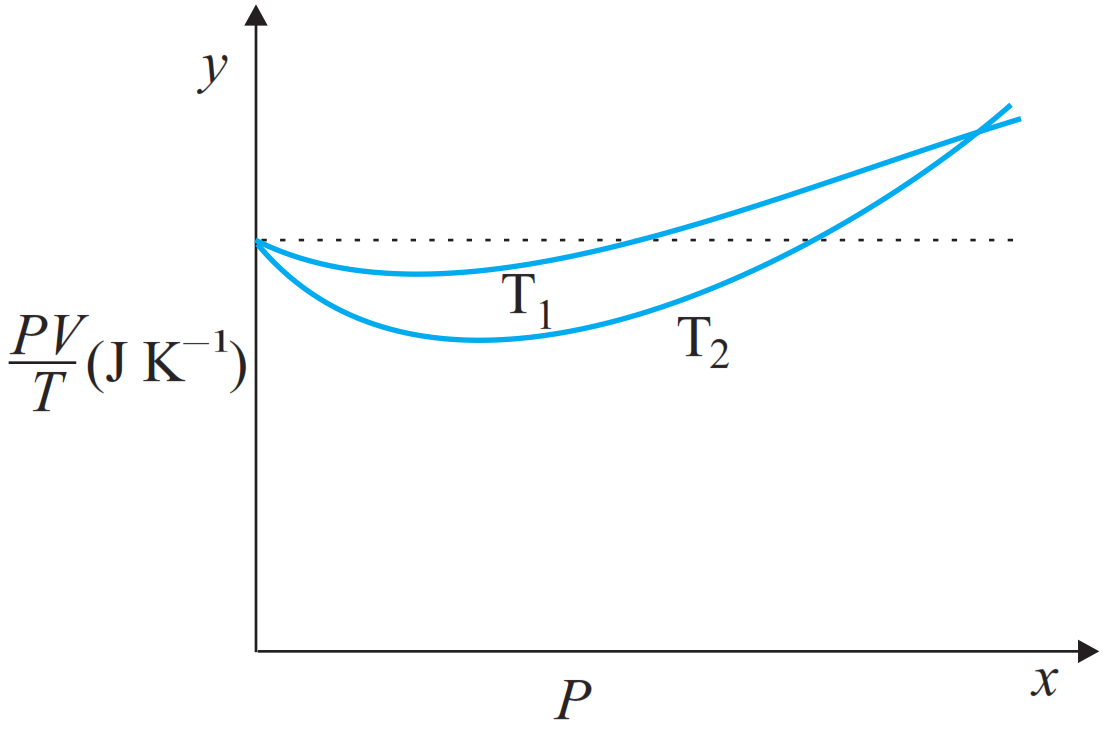
Shows plot of $\frac{\text{PV}}{\text{T}}$ versus P for 1.00 × 10⁻³kg of oxygen gas at two different temperatures:

If we obtained similar plots for 1.00 × 10⁻³kg of hydrogen, would we get the same value of $\frac{\text{PV}}{\text{T}}$ at the point where the curves meet on the y-axis? If not, what mass of hydrogen yields the same value of $\frac{\text{PV}}{\text{T}}$ (for low pressure high temperature region of the plot)? (Molecular mass of H2 = 2.02u, of O2 = 32.0u, R = 8.31J mo1-1K-1).

A transverse harmonic wave travelling on a string is described by $\text{y(x, t})=3.0\sin\Big[(36\text{t}+0.018\text{x})+\frac{\pi}{4}\Big]$ where x and y are in cm and t in s. The positive direction of x is from left to right.
  1. What are the speed and direction of propagation of the wave?
  2. What are its amplitude and frequency?
  3. What is the initial phase at the origin?
  4. What is the least distance between two successive crests in the wave?
A pipe 20cm long is closed at one end. Which harmonic mode of the pipe is resonantly excited by a 430Hz source? Will the same source be in resonance with the pipe if both ends are open? (speed of sound in air is 340m s–1).
State the conservation of linear momentum. Explain linear momentum conservation in a two particle system with an example. Or Under what circumstances does linear momentum conservation occur? For two interacting particles prove that linear momentum will be conserved in the absence of external forces.
Natural water contains a small amount of tritium $\big(\text{ }^3_1\text{H}\big).$ This isotope beta-decays with a half-life of 12.5 years. A mountaineer while climbing towards a difficult peak finds debris of some earlier unsuccessful attempt. Among other things he finds a sealed bottled of whisky. On returning, he analyses the whisky and finds that it contains only 1.5 per cent of the $\text{}^3_1\text{H}$ radioactivity as compared to a recently purchased bottle marked '8 years old'. Estimate the time of that unsuccessful attempt.
Define impulse and establish its relation with momentum change. Explain the importance of impulse. Or Define impulse of a force and prove that the impulse of a force on a body is equal to change in momentum. Or State the momentum impulse theorem. Explain its physical importance with examples.