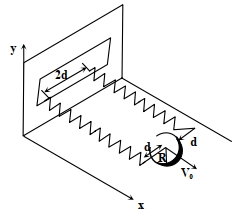
A uniform thin cylindrical disk of mass $\mathrm{M}$ and radius $\mathrm{R}$ is attached to two identical massless springs of spring constant $\mathrm{k}$ which are fixed to the wall as shown in the figure. The springs are attached to the axle of the disk symmetrically on either side at a distance $\mathrm{d}$ from its centre. The axle is massless and both the springs and the axle are in horizontal plane. The unstretched length of each spring is $L$. The disk is initially at its equilibrium position with its centre of mass $(CM)$ at a distance $L$ from the wall. The disk rolls without slipping with velocity $\overrightarrow{\mathrm{V}}_0=\mathrm{V}_0 \hat{\mathrm{i}}$. The coefficient of friction is $\mu$. Figure:$Image$
$1.$ The net external force acting on the disk when its centre of mass is at displacement $\mathrm{x}$ with respect to its equilibrium position is
$(A)$ $-\mathrm{kx}$ $(B)$ $-2 k x$ $(C)$ $-\frac{2 \mathrm{kx}}{3}$ $(D)$ $-\frac{4 k x}{3}$
$2.$ The centre of mass of the disk undergoes simple harmonic motion with angular frequency $\omega$ equal to
$(A)$ $\sqrt{\frac{k}{M}}$ $(B)$ $\sqrt{\frac{2 \mathrm{k}}{\mathrm{M}}}$ $(C)$ $\sqrt{\frac{2 \mathrm{k}}{3 \mathrm{M}}}$ $(D)$ $\sqrt{\frac{4 \mathrm{k}}{3 \mathrm{M}}}$
$3.$ The maximum value of $\mathrm{V}_0$ for which the disk will roll without slipping is
$(A)$ $\mu g \sqrt{\frac{\mathrm{M}}{\mathrm{k}}}$ $(B)$ $\mu g \sqrt{\frac{M}{2 k}}$ $(C)$ $\mu g \sqrt{\frac{3 M}{k}}$ $(D)$ $\mu g \sqrt{\frac{5 \mathrm{M}}{2 \mathrm{k}}}$
Give the answer question $1,2$ and $3.$