MCQ
A triglyceride can have how many different acyl groups?
  • A
    $3$
  • B
    $2$
  • $1$
  • D
    $4$

Answer

Correct option: C.
$1$
c
$ClC{H_2}C{H_2}OH$ is stronger acid than $C{H_3}C{H_2}OH$ due to $-\,I$ effect of $Cl$.

$Cl\, \leftarrow \,\mathop {C{H_2}C{H_2}OH}\limits_{Stronger\,\,acid}  \to \,$ $\,Cl\,\leftarrow \,\underset{\begin{smallmatrix} 
 -ve\,\,charge\,\,on\,\,O \\ 
 dispersed\,\,hence 
 \\ 
 conjugate\,\,base,\,stable 
\end{smallmatrix}}{\mathop{C{{H}_{2}}C{{H}_{2}}{{O}^{-}}\,}}\,+\,{{H}^{+}}$

$\underset{Weaker \,\,acid}{\mathop{C{{H}_{3}}C{{H}_{2}}OH}}\,\,\to \underset{\begin{smallmatrix} 
 -\,\,ve\,\,charge\,\,\operatorname{int}ensified, \\ 
 \,\,\,\,\,\,\,\,hence\,\,conjugatte 
 \\ 
 \,\,\,\,\,\,\,\,base\,\,unstable 
\end{smallmatrix}}{\mathop{C{{H}_{3}}\to \,C{{H}_{2}}{{O}^{-}}\,+}}\,\,{{H}^{+}}$

Need a full question paper?

Generate a complete, print-ready paper with questions like this in minutes — across 16+ boards, with answer keys.

Start Generating Free

Similar questions

The reagent used for dehydrohalogenation is ____________.
The following reaction belongs to ${(C{H_3})_3}C - Br\xrightarrow{{{H_2}O}}\;{(C{H_3})_3} - C - OH$
A compound $H _2 X$ with molar weight of $80 g$ is dissolved in a solvent having density of $0.4 \ g ml ^{-1}$. Assuming no change in volume upon dissolution, the molality of a $3.2$ molar solution is
Reagents to carry out above conversion, $P, Q, R$ respectively are
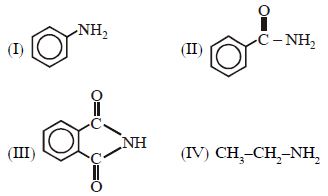
Find the correct order of acidity of the following compounds
Transition metals are coloured due to the following electronic transition:
In electroplating, the article to be electroplated serves as
 Which of the following optioms correctly represents relationship between $t_{7/8}$ and $t_{1/2}$ where $t_{7/8}$ represent time required for concentration to become $\frac{1}{8} \,th$ of original for  a reaction of order $'n'$
Number of complexes with even number of electrons in $\mathrm{t}_{2 \mathrm{~g}}$ orbitals is -

${\left[\mathrm{Fe}\left(\mathrm{H}_2 \mathrm{O}\right)_6\right]^{2+},\left[\mathrm{Co}\left(\mathrm{H}_2 \mathrm{O}\right)_6\right]^{2+},\left[\mathrm{Co}\left(\mathrm{H}_2 \mathrm{O}\right)_6\right]^{3+},}$

${\left[\mathrm{Cu}\left(\mathrm{H}_2 \mathrm{O}\right)_6\right]^{2+},\left[\mathrm{Cr}\left(\mathrm{H}_2 \mathrm{O}\right)_6\right]^{2+}}$

The correct match between Item$-I$ (starting material) and Item$-II$ (reagent) for the preparation of benzaldehyde is :

Item$-I$                                Item$-II$ 

$(I)$ Benzene                      $( P )$ $HCl$ and $SnCl _{2}, H _{3} O ^{+}$

$(II)$ Benzonitrile                $(Q)$ $H _{2}, Pd - BaSO _{4}, S$ and quinoline

$(III)$ Benzoyl Chloride      $(R)$ $CO , HCl$ and $AlCl _{3}$