MCQ
A tuning fork vibrating with a sonometer having $20 cm$ wire produces $5$ beats per second. The beat frequency does not change if the length of the wire is changed to $21 cm.$ the frequency of the tuning fork (in Hertz) must be
  • A
    $200$
  • B
    $210$
  • $205$
  • D
    $215$

Answer

Correct option: C.
$205$
c
(c) Let the frequency of tunning fork be $N$
As the frequency of vibration string $ \propto \frac{1}{{{\rm{length}}\;{\rm{of}}{\rm{string}}}}$
For sonometer wire of length $20 cm$, frequency must be $(N + 5)$ and that for the sonometer wire of length $21cm,$ the frequency must be $(N -5)$ as in each case the tunning fork produces $5$ beats/sec with sonometer wire
Hence ${n_1}{l_1} = {n_2}{l_2}$

==> $(N + 5) \times 20 = (N - 5) \times 21$

==> $N = 205Hz.$

Need a full question paper?

Generate a complete, print-ready paper with questions like this in minutes — across 16+ boards, with answer keys.

Start Generating Free

Similar questions

A wave represented by the equation $y_1 = a\,cos(Kx-\omega t)$ is superimposed with another wave to form a stationary wave such that the point $x = 0$ is a node. The equation for the other wave is
Two balls $A$ and $B$ having masses $1\, kg$ and $2\, kg$, moving with speeds $21\, m/s$ and $4\, m/s$ respectively in opposite direction, collide head on. After collision Amoves with a speed of $1\, m/s$ in the same direction, then the coefficient of restitution is
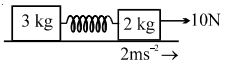
Find the acceleration of $3 kg$ mass when acceleration of $2 kg$ mass is $2 ms^{^{-2}}$ as shown in figure. ......... $ms^{-2}$
Which of the following physical quantities is different from others?
The angle between $\vec{\text{A}}=\hat{\text{i}}+\hat{\text{j}}$ and $\vec{\text{B}}=\hat{\text{i}}-\hat{\text{j}}$ is
  1. 45°
  2. 90°
  3. –45°
  4. 180°
There are $100$ divisions on the circular scale of a screw gauge of pitch $1 \mathrm{~mm}$. With no measuring quantity in between the jaws, the zero of the circular scale lies $5$ divisions below the reference line. The diameter of a wire is then measured using this screw gauge. It is found the $4$ linear scale divisions are clearly visible while $60$ divisions on circular scale coincide with the reference line. The diameter of the wire is :
In a rocket of mass $1000\, kg$ fuel is consumed at a rate of $40 \,kg/s$. The velocity of the gases ejected from the rocket is $5 \times {10^4}\,m/s$. The thrust on the rocket is
Water rises in a vertical capillary tube upto a length of 10cm. If the tube is inclined at 45°, the length of water risen in the tube will be:

  1. $10\text{cm}$

  2. $10\sqrt{2}\text{cm}$

  3. $\frac{10}{\sqrt{2}}\text{cm}$

  4. None of these.

During an isothermal expansion of an ideal gas
In the motion of a projectile freely under gravity, its