Question
A U- tube containing a liquid is accelerated horizontally with a constant acceleration a0. If the separation between the vertical limbs is 1, find the difference in the heights of the liquid in the two arms.

Answer

Let the pressure at the base of the back limb at A = P, and the pressure at the base of the front limb at B = Ps. The separation between the vertical limbs AB = (given). When the U- tube is accelerated at an acceleration a, the difference of pressure between horizontal points A and B is given as,

$\text{P}_\text{a}-\text{P}_\beta=\text{l}\rho\text{a}_0$
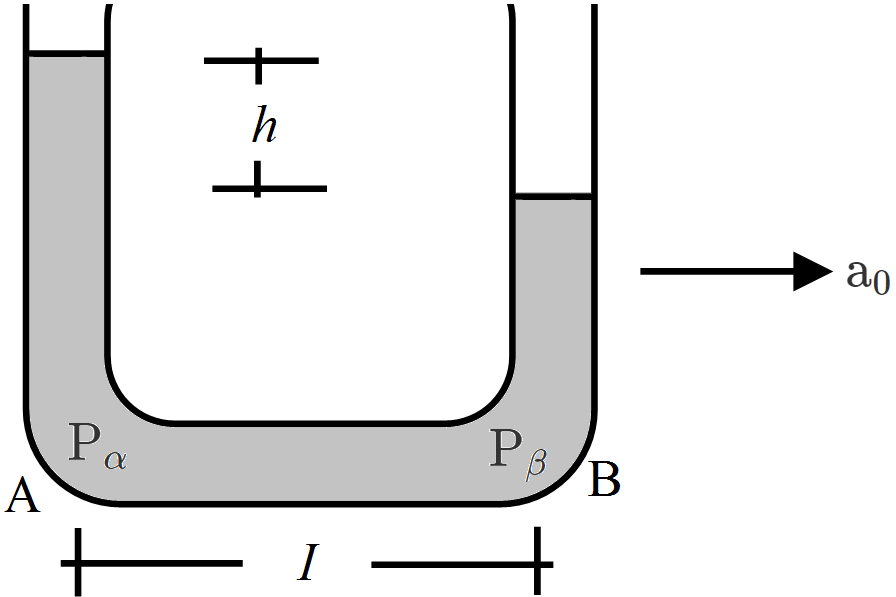
where p is the density of the liquid. Due to this pressure difference, the liquid in limb A will rise to a heighth more than in limb B. The pressure difference due to this height difference balances the difference of pressure between points A and B.

The pressure due to thhis height $\text{h}=\rho\text{gh},$ Equating we get,

$\rho\text{gh}=\text{p}_\text{a}-\text{p}_\beta=\text{l}\rho\text{a}_0$

$\Rightarrow\text{gh}=\text{la}_0$

$\text{h}=\text{a}_0\text{l}/\text{g}$

Need a full question paper?

Generate a complete, print-ready paper with questions like this in minutes — across 16+ boards, with answer keys.

Start Generating Free

Similar questions

A gas is enclosed in a cylindrical vessel fitted with a frictionless piston. The gas is slowly heated for some time. During the process, 10J of heat is supplied and the piston is found to move out 10cm. Find the increase in the internal energy of the gas. The area of cross section of the cylinder = 4cm2 and the atmospheric pressure = 100kPa.
A projectile is fired from the top of a 40m high cliff with an initial speed of 50m/s at an unknown angle. Find its speed when it hits the ground.
Write the mathematical relation between mobility and drift velocity of charge carriers in a conductor. Name the mobile charge carriers responsible for conduction of electric current in (i) an electrolyte (ii) an ionised gas.
Explain with example why matter particle acquires electric charge.
A nearsighted person cannot clearly see beyond 200cm. Find the power of the lens needed to see objects at large distances.
Give explanation of linearly pofarized, unpolarized and plane polarized wave.
A converging lens and a diverging lens of the same focal length are placed coaxially in contact with each other. Find the focal length and power of the combination.
If light of wavelength 412·5nm is incident on each of the metals given below, which ones will show photoelectric emission and why?
Metal
Work Function (eV)
Na
1.92
K
2.15
Ca
3.20
Mo
4.17
A potential difference $V$ is applied across the ends of a conductor of length $L$ and diameter $D$. What will be the effect on drift velocity of charge carriers in the conductor when (i) V is made half (ii) L is doubled and (iii) D is made half?
Find the value of capacitance between points P and N of the connection shown in the figure when (a) switch S is open, (b) switch S is closed. Here $C =1 \mu F$ and $C _2=2 \mu F$.