Question

A uniform electric field and a uniform magnetic field are produced, pointed in the same direction. An electron is projected with its velocity pointing in the same direction

(a) The electron will turn to its right

(b) The electron will turn to its left

(c) The electron velocity will increase in magnitude

(d) The electron velocity will decrease in magnitude

Answer

(d) The electron velocity will decrease in magnitude

Need a full question paper?

Generate a complete, print-ready paper with questions like this in minutes — across 16+ boards, with answer keys.

Start Generating Free

Similar questions

The work done in placing a charge of 8 × 10-18 coulomb on a condenser of capacity 100 micro-farad is:
Mark the correct statements:
  1. The magnitude of the velocity of a particle is equal to its speed.
  2. The magnitude of average velocity in an interval is equal to its average speed in that interval
  3. It is possible to have a situation in which the speed of a particle is always zero but the average speed is not zero.
  4. It is possible to have a situation in which the speed of the particle is never zero but the average speed in an interval is zero.

Work function of a metal is 2.51 eV. Its threshold frequency is

(a) 5.9  cycle/sec

(b) 6.5  cycle/sec

(c) 9.4  cycle/sec

(d) 6.08  cycle/sec

The reason of colour in thin film is :

The induction coil works on the principle of

(a) Self-induction

(b) Mutual induction

(c) Ampere's rule

(d) Fleming's right hand rule

While using an electric bulb, the reflection for street lighting should be from

(a) Concave mirror

(b) Convex mirror

(d) Parabolic mirror

(d) Parabolic mirror

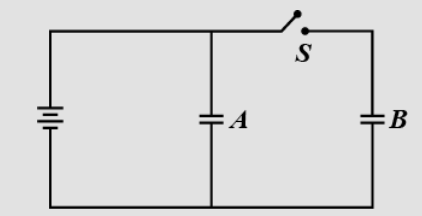
Two identical air filled parallel plate capacitors are charged to the same potential in the manner shown by closing the switch S. If now the switch S is opened and the space between the plates is filled with a dielectric of relative permittivity εr​, then:

The change in frequency due to Doppler effect does not depend on:
  1. The speed of the source.
  2. The speed of the observer.
  3. The frequency of the source.
  4. Separation between the source and the observer.

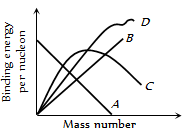
Binding energy per nucleon plot against the mass number for stable nuclei is shown in the figure. Which curve is correct

(a) A

(b) B

(c) C

(d) D

A radio receiver antenna that is 2 m long is oriented along the direction of the electromagnetic wave and receives a signal of intensity 5 . The maximum instantaneous potential difference across the two ends of the antenna is

(a) 1.23 mV

(b) 1.23 mV

(c) 1.23 V  

(d) 12.3 mV