Question
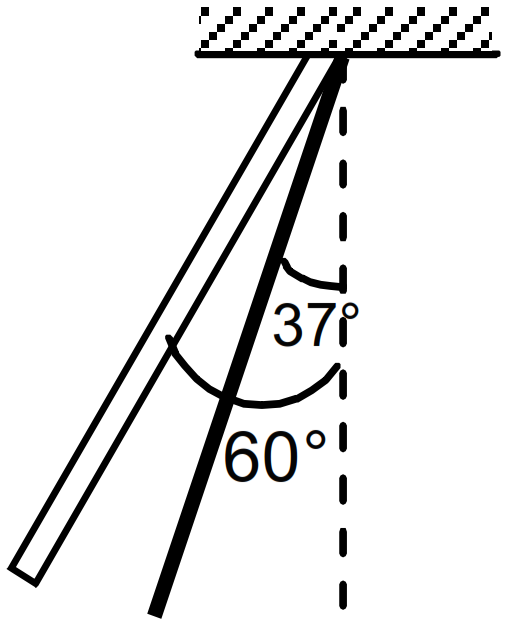
A uniform rod pivoted at its upper end hangs vertically. It is displaced through an angle of $60^\circ$ and then released. Find the magnitude of the force acting on a particle of mass dm at the tip of the rod when the rod makes an angle of $37^\circ$ with the vertical.
Answer


Let $l = $length of the rod, and $m =$ mass of the rod. Applying energy principle $\Big(\frac{1}{2}\Big)\text{l}\omega^2-0=\text{mg}\Big(\frac{1}{2}\Big)(\cos37^\circ-\cos60^\circ)$
$\Rightarrow\frac{1}{2}\times\frac{\text{ml}^2}{3}\omega^2$
$=\text{mg}\times\frac{1}{2}\Big(\frac{4}{5}-\frac{1}{2}\Big)\text{t}$
$\Rightarrow\omega^2=\frac{9\text{g}}{10\text{l}}=0.9\Big(\frac{\text{g}}{\text{l}}\Big)$
Again $\Big(\frac{\text{ml}^2}{3}\Big)\alpha=\text{mg}\Big(\frac{1}{2}\Big)\sin37^\circ=\text{mgl}\times\frac{3}{5}$
$\therefore\alpha=0.9\Big(\frac{\text{g}}{\text{l}}\Big)=$ angular acceleration.
So, to find out the force on the particle at the tip of the rod $F_i =$ centrifugal force $=(\text{dm})\omega^2\text{l}=0.9(\text{dm})\text{g} F_t =$ tangential force $=(\text{dm})\alpha\text{l}=0.9(\text{ dm})\text{g}$
So, total force $\text{F}=\sqrt{\big(\text{F}_{\text{i}}^2+\text{F}_{\text{t}}^2\big)}=0.9\sqrt2(\text{dm})\text{g}$

Need a full question paper?

Generate a complete, print-ready paper with questions like this in minutes — across 16+ boards, with answer keys.

Start Generating Free

Similar questions

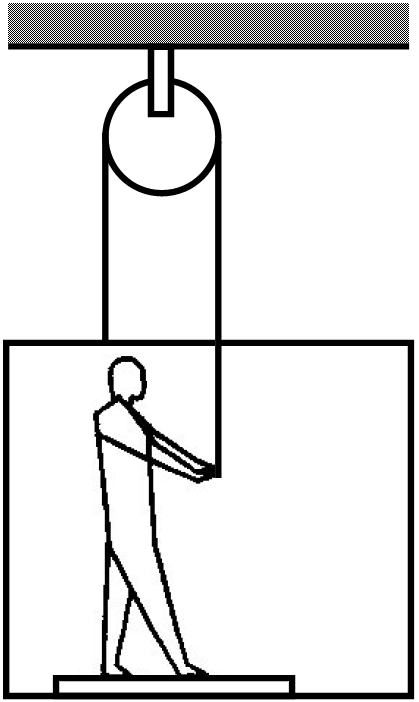
Figure shows a man of mass $60\ kg$ standing on a light weighing machine kept in a box of mass $30\ kg$. The box is hanging from a pulley fixed to the ceiling through a light rope, the other end of which is held by the man himself. If the man manages to keep the box at rest, what is the weight shown by the machine? What force should he exert on the rope to get his correct weight on the machine?
Suppose India had a target of producing by $2020 AD, 200,000 MW$ of electric power, ten percent of which was to be obtained from nuclear power plants. Suppose we are given that, on an average, the efficiency of utilization $($i.e. conversion to electric energy$)$ of thermal energy produced in a reactor was $25\%$. How much amount of fissionable uranium would our country need per year by $2020$ ? Take the heat energy per fission of $^{235}\text{U}$ to be about $200MeV$.
A solenoid is connected to a battery so that a steady current flows through it. If an iron core is inserted into the solenoid, will the current increase or decrease? Explain.
Explain the concept of energy bands with a figure.
The half $-$ life of $^{199}Au$ is $2.7$ days.
  1. Find the activity of a sample containing $1.00\mu\text{g}$ of $^{198}Au.$
  2. What will be the activity after $7$ days? Take the atomic weight of ${198}Au$ to be $198g/mol$.
A magnetic field set up using Helmholtz coils $($described in Exercise $4.16)$ is uniform in a small region and has a magnitude of $0.75 T.$ In the same region, a uniform electrostatic field is maintained in a direction normal to the common axis of the coils. A narrow beam of $($single species$)$ charged particles all accelerated through $15 kV$ enters this region in a direction perpendicular to both the axis of the coils and the electrostatic field. If the beam remains undeflected when the electrostatic field is $9.0 \times 10^{–5} V m^{–1},$ make a simple guess as to what the beam contains. Why is the answer not unique?
An ideal gas having density $1.7 \times 10^{-3}g-cm^{-3}$ at a pressure $1.5 \times 10^5Pa$ is filled in a Kundt tube. When the gas is resonated at a frequency of $3.0KHz$, nodes are formed at a separation of 6.0\ cm. Calculate the molar heat capacities $C_P$ and $C_v$ of the gas.
Suppose the ends of the coil in the previous problem are connected to a resistance of $100\Omega.$ Neglecting the reaiatance of the coil, find the heat produced in the circuit in one minute.
A gun of mass M fires a bullet of mass m with a horizontal speed V. The gun is fitted with a concave mirror of focal length f facing tpwards the receding bullet. Find the speed of separation of the bullet and the image just after the gun was fired.
Suppose that the radius of cross-section of the wire used in the previous problem is r. Find the increase in the radius of the loop if the magnetic field is switched off. Young's modulus of the material of the wire is Y.