MCQ
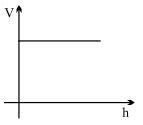
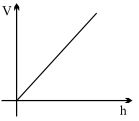
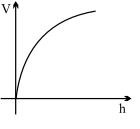
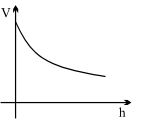
A uniform rope having some mass hanges vertically from a rigid support. A transverse wave pulse is produced at the lower end. The speed $(v)$ of the wave pulse varies with height $(h)$ from the lower end as:
  • A

  • B


  • D

Answer

Correct option: C.

c
$v=\sqrt{\frac{T}{\mu}}=\sqrt{\frac{\mu x g}{\mu}}=\sqrt{g x} \Rightarrow v^{2}=g x$

Need a full question paper?

Generate a complete, print-ready paper with questions like this in minutes — across 16+ boards, with answer keys.
Start Generating Free

Similar questions

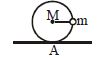
A uniform body of mass $M$  radius $R$ has a small mass $m$ attached at edge as shown in the figure. The system is placed on a perfectly rough horizontal surface such that mass $m$ is at the same horizontal level as the centre of body. It is assumed that there is no slipping at point $A$. If $I_A$ is the moment of the inertia of combined system about point of contact $A$ then the normal reaction at point $A$ just after the system is released from rest is ........ $N$. ($M = 6\ kg$, $m = 2\ kg,$ $I_A = 4\ kg\ m^2$, $R = 1\ m$, $g=10\ m/s^2$)
Two moles of helium are mixed with $n$  with moles of hydrogen. If $\frac{{{C_P}}}{{{C_V}}}\, = \,\frac{3}{2}$  for the mixture, then the value of $n$  is
The molar heat capacity of oxygen gas at $\text{STP}$ is nearly $2.5R.$ As the temperature is increased, it gradually increases and approaches $3.5R.$ The most appropriate reason for this behaviour is that at high temperatures:
One end of a long metallic wire of length $L$ is tied to the ceiling. The other end is tied to massless spring of spring constant $K$. A mass $ m$ hangs freely from the free end of the spring. The area of cross-section and Young's modulus of the wire are $A$ and $Y$ respectively. If the mass is slightly pulled down and released, it will oscillate with a time period $T$ equal to
A string is wound round the rim of a mounted flywheel (Disc) of mass $20\,kg$ and radius $20\,cm$ . A steady pull of $25\,N$ is applied on the cord. Neglecting friction and mass of the string, the angular acceleration of the wheel in $rad/s^2$ is
A wire of length $30\,cm$, stretched between rigid supports, has it's $n^{\text {th}}$ and $(n+1)^{\text {th}}$ harmonics at $400\,Hz$ and $450\; Hz$, respectively. If tension in the string is $2700\,N$, it's linear mass density is.........$kg/m$.
A gas is expanded isothermally from volume $V_1$ to $V_2$ at a constant temperature $T,$ the work done by the gas in this expansion is:
For a gas the difference between the two specific heats is $4150\, J/kg\, K.$ What is the specific heats at constant volume of gas if the ratio of specific heat is $1.4$
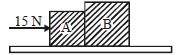
On a smooth plane surface (figure) two block $A$ and $B$ are accelerated up by applying a force $15\, N$ on $A$. If mass of $B$ is twice that of $A$, the force on $B$ is  ........... $N$
A ball of mass $m$ is thrown vertically upward. Another ball of mass $2\,m$ is thrown an angle $\theta$ with the vertical. Both the balls stay in air for the same period of time. The ratio of the heights attained by the two balls respectively is $\frac{1}{x}$. The value of $x$ is $.....$