MCQ
A uniform spherical planet (Radius $R$) has acceleration due to gravity at its surface $g.$ Points $P$ and $Q$ located inside and outside the planet have acceleration due to gravity $\frac{g}{4} .$ Maximum possible separation between $P$ and $Q$ is
  • A
    $\frac{{7R}}{4}$
  • B
    $\frac{{3R}}{4}$
  • $\frac{{9R}}{4}$
  • D
    none

Answer

Correct option: C.
$\frac{{9R}}{4}$
c
variation with depth

$g_{d}=g(1-d / R)$

$\frac{g}{4}=g(1-d / R)$

$\frac{d}{R}=3 / 4$

$a=3 R / 4$

variation with height

$g_{h}=g\left(1-\frac{2 h}{R}\right)$

$\frac{g}{4}=g\left(1-\frac{2 h}{R}\right)$

$\frac{2 h}{R}=\frac{3}{4}$

$h=\frac{3 R}{8}$

max distance $=a+h=\frac{3 R}{4}+\frac{3 R}{8}$

$=\frac{9 R}{8}$

Need a full question paper?

Generate a complete, print-ready paper with questions like this in minutes — across 16+ boards, with answer keys.

Start Generating Free

Similar questions

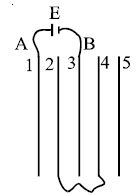
Five conducting parallel plates having area $A$ and separation between them $d$, are placed as shown in the figure. Plate number $2$ and $4$ are connected wire and between point $A$ and $B$, a cell of emf $E$ is connected. The charge flown through the cell is
Assertion : Goggles have zero power.

Reason : Radius of curvature of both sides of lens is same.

Two identical capacitors are connected in parallel across a potenial difference $V$. After they are fully charged, the positive plate of first capacitor is connected to negative plate of second and negative plate of first is connected to positive plate of other. The loss of energy will be
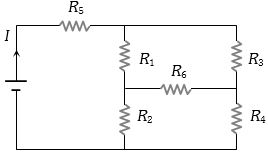
In the given circuit, it is observed that the current $I$ is independent of the value of the resistance $R_6$. Then the resistance values must satisfy
Four wires of the same diameter are connected in turn between two points, maintained at a constant potential difference. Their resistivities are; $\rho $ and $L$ (wire $1$ )., $1.2\,\rho $ and $1.2\,L$ (wire $2$ ), $0.9\,\rho $ and $0.9\,L$ (wire $3$ ) and $\rho $ and $1.5\,L$ (wire $4$ ). Rank the wires according to the rates at which energy is dissipated as heat, greatest first
An isolated rail car of mass $M$ is moving along a straight, frictionless track at an initial speed $v_0$. The car is passing under a bridge when $a$ crate filled with $N$ bowling balls, each of mass $m$, is dropped from the bridge into the bed of the rail car. The crate splits open and the bowling balls bounce around inside the rail car, but none of them fall out. What is the average speed of the rail car $+$ bowling balls system some time after the collision?
With rise in temperature, density of a given body changes according to one of the following relations
In a radioactive material, fraction of active material remaining after time $t$ is $\frac{9}{16}$ The fraction that was remaining after $\frac{t}{2}$ is 
At what distance above and below the surface of the earth a body will have same weight, (take radius of earth as $R$.)
From a disc of radius $R$ and mass $M,$ a circular hole of diameter $R,$ whose rim passes through the centre is cut. What is the moment of inertia of the remaining part of the disc about a perpendicular axis, passing through the centre?