Question
✓
Answer
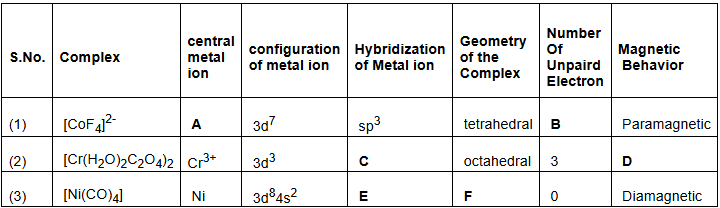
(a).A = Co2+
B = 3
C = d2sp3
D = Paramagnetic
E = sp3
F = tetrahedral
(b). (i) Cr2O72- + 8 H+ + 3 H2S → 2 Cr3+ + 3S + 7 H₂O
(ii) Cr2O72- + 14 H+ 6 Fe2+ 2 Cr³+ + 6 Fe3+ + 7 H₂O
B = 3
C = d2sp3
D = Paramagnetic
E = sp3
F = tetrahedral
(b). (i) Cr2O72- + 8 H+ + 3 H2S → 2 Cr3+ + 3S + 7 H₂O
(ii) Cr2O72- + 14 H+ 6 Fe2+ 2 Cr³+ + 6 Fe3+ + 7 H₂O
Need a full question paper?
Generate a complete, print-ready paper with questions like this in minutes — across 16+ boards, with answer keys.
Explore more
Similar questions
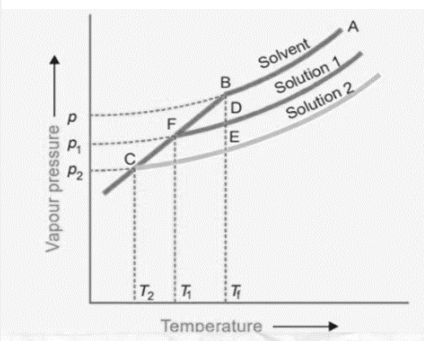
(a). An experiment was carried out in the laboratory, to study depression in freezing point. 1M aqueous solution of Al(NO3)3 and 1 M aqueous solution of glucose were taken. From the given figure identify solution 1 and solution 2. Give a plausible reason for your answer
(b). The osmotic pressure of a solution of cane sugar was found to be 2.46 atm at 300 K. If the solution was diluted five times, calculate the osmotic pressure at the same temperature.
How can the osmotic pressure of the given cane sugar solution be decreased without changing its volume? Give a reason for your answer.
(b). The osmotic pressure of a solution of cane sugar was found to be 2.46 atm at 300 K. If the solution was diluted five times, calculate the osmotic pressure at the same temperature.
How can the osmotic pressure of the given cane sugar solution be decreased without changing its volume? Give a reason for your answer.
Discuss aldol condensation in detail.
Match the property given in Column I with the element given in Column II.
| | Column I (Property) | | Column II (Element) |
| (i) | Lanthanoid which shows +4 oxidation state | (a) | Pm |
| (ii) | Lanthanoid which can show +2 oxidation state | (b) | Ce |
| (iii) | Radioactive lanthanoid | (c) | Lu |
| (iv) | Lanthanoid which has 4f7 electronic configuration in +3 oxidation state | (d) | Eu |
| (v) | Lanthanoid which has 4f14 electronic configuration in +3 oxidation state | (e) | Gd |
| | | (f) | Dy |
What happens when:
(a) Propene is passed into concentrated $H _2 SO _4$ and the product is boiled with water.
(b) Methoxy ethane is heated with HI.
(c) Ethanol is heated with Fenton's reagnet.
(d) Toluene is heated with Chromyl Chloride in $CS _2$ and the product is hydrolysed.
(e) Crotonaldehyde is treated with $LiAH _4 / dry$ ether and the product is acid hydrolysed.
→(a) Propene is passed into concentrated $H _2 SO _4$ and the product is boiled with water.
(b) Methoxy ethane is heated with HI.
(c) Ethanol is heated with Fenton's reagnet.
(d) Toluene is heated with Chromyl Chloride in $CS _2$ and the product is hydrolysed.
(e) Crotonaldehyde is treated with $LiAH _4 / dry$ ether and the product is acid hydrolysed.
Explain in detail the changing oxidation states of the elements of d group (transition elements) in the context of 3d series.
Describe the reactions of -COOH group present in carboxylic acids.
(i) Define molecularity of a reaction.
(ii) Explain the effect of presence of catalyst on the rate of reaction.
(iii) In a first order reaction at 300 K , the initial concentration of the reactant was $1.0 \times 10^{-2} mol L ^{-1}$, which decreased to $0.5 \times 10^{-2} molL ^{-1}$ after 30 minutes at 300 K . Calculate the rate constant of the reactant at 300 K. $[\log 2=0.3010] \quad$
→(ii) Explain the effect of presence of catalyst on the rate of reaction.
(iii) In a first order reaction at 300 K , the initial concentration of the reactant was $1.0 \times 10^{-2} mol L ^{-1}$, which decreased to $0.5 \times 10^{-2} molL ^{-1}$ after 30 minutes at 300 K . Calculate the rate constant of the reactant at 300 K. $[\log 2=0.3010] \quad$
Explain different types of isomerism in amines.
Derive formula for degree of dissociation and degree of condensation of the solute in the solvent.
(a). Out of formic acid and acetic acid, which one will give the HVZ reaction? Give a suitable reason in support of your answer and write the chemical reaction involved.
(b). Alcohols are acidic but they are weaker acids than water. Arrange various isomers of butanol in the increasing order of their acidic nature. Give a reason for the same.
(c). An organic compound A which is a Grignard reagent is used to obtain 2-methylbutan-2-ol on reaction with a carbonyl compound 'B'. Identify A' and 'B'. Write the equation for the reaction between A and B.
(b). Alcohols are acidic but they are weaker acids than water. Arrange various isomers of butanol in the increasing order of their acidic nature. Give a reason for the same.
(c). An organic compound A which is a Grignard reagent is used to obtain 2-methylbutan-2-ol on reaction with a carbonyl compound 'B'. Identify A' and 'B'. Write the equation for the reaction between A and B.