MCQ
 A variable condenser is permanently connected to a $100 V$ battery. If the capacity is changed from $2\mu F$ to $10\ \mu F,$ then change in energy is equal to
  • A
    $2 \times 10^{-2} J$
  • B
    $2.5 \times 10^{-2} J$
  • C
    $3.5 \times 10^{-2} J$
  • $4 \times 10^{-2} J$

Answer

Correct option: D.
$4 \times 10^{-2} J$

Need a full question paper?

Generate a complete, print-ready paper with questions like this in minutes — across 16+ boards, with answer keys.

Start Generating Free

Similar questions

In an experiment of photoelectric effect the number of photoelectrons has to be increased without changing their frequency. The suitable step to be taken about the incident radiation for this is:
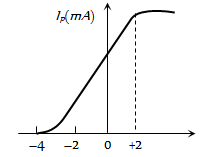
The mutual characteristic curves of a triode are as shown in figure. The cut off voltage for the triode is
How does the capacitance change with the effect of the dielectric when the battery remains connected across the capacitor?
Following operations can be performed on a capacitor:
$X -$ connect the capacitor to a battery of emf $\epsilon.$
$Y -$ disconnect the battery.
$Z -$ reconnect the battery with polarity reversed.
$W -$ insert a dielectric slab in the capacitor.
As the mass number A increases, which of the following quantities related to a nucleus do not change?
In the propagation of light waves, the angle between the plane of vibration & plane of polarisation is:
A radioactive substance has a half life of 60 minutes. After 3 hours, the fraction of atom that have decayed would be(a)12.5%(b) 87.5%(c) 8.5%  (d) 25.1%
       
What is the unit of surface charge density in the $SI$ unit?
Light of wavelength $4000 \mathring A$  falls on a photosensitive metal and a negative $2V$ potential stops the emitted electrons. The work function of the material $($in $eV)$ is approximately $(h = 6.6 \left.\times 10^{-34} \mathrm{Js}, \mathrm{e}=1.6 \times 10^{-19} \mathrm{C}, \mathrm{c}=3 \times 10^8 \mathrm{~ms}^{-1}\right)$
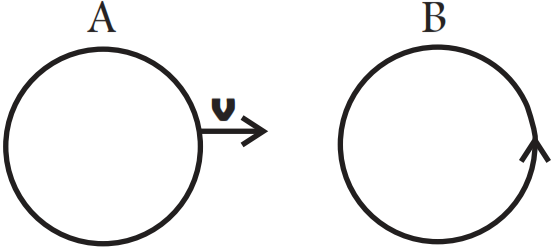
There are two coils A and B as shown in Fig. A current starts flowing in B as shown, when A is moved towards B and stops when A stops moving. The current in A is counterclockwise. B is kept stationary when A moves. We can infer that: