Question
A variable frequency a.c source is connected to a capacitor. How will the displacement current change with decrease in frequency?

Answer

Capacitive reaction $\text{X}_\text{C}=\frac{1}{2\pi\text{fC}}$
Hence, $\text{X}_\text{C}\propto\frac{1}{\text{f}}$
As frequency decreases, XC increases and the conduction current is inversely proportional to $\text{X}_\text{C}\Big(\because\text{I}\propto\frac{1}{\text{X}_\text{C}}\Big)$.
It means the displacement current decreases as the conduction current is equal to the displacement current.

Need a full question paper?

Generate a complete, print-ready paper with questions like this in minutes — across 16+ boards, with answer keys.
Start Generating Free

Similar questions

Area of a plane loop is A . Current I is flowing through it and it is located in a uniform magnetic field $\overrightarrow{ B }$. Obtain an expression for torque $\vec{\tau}$ acting on it. If this loop is free to rotate then what will be its orientation in stable position?
The drift speed is defined as $\text{v}_\text{d}=\frac{\Delta\text{l}}{\Delta\text{t}}$ where $\Delta\text{l}$ is the distance drifted in a long time $\Delta\text{t}.$ Why don't we define the drift speed as the limit of $\frac{\Delta\text{l}}{\Delta\text{t}}\ \text{as}\ \Delta\text{t}\rightarrow0?$
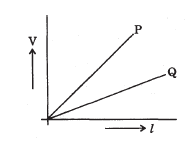
The variation of potential difference V with lengthlin case of two potentiometers P and Q is as shown. Which one of these two will you prefer for comparing emfs of two primary cells?
Does the stopping potential in photoelectric emission depend upon,
  1. The intensity of the incident radiation in a photocell?
  2. The frequency of the incident radiation?
If magnitude of current is made twice in any inductor, then how many times will the stored energy become?
The elastic limit of steel is $8 \times 10^8N/m^2$ and its Young's modulus $2 \times 10^{11}N/m^2.$ Find the maximum elongation of a half meter steel wire that can be given without exceeding the elastic limit.
Find the excess pressure inside:
  1. A drop of mercury of radius $2\ mm$.
  2. A soap bubble of radius $4\ mm$.
  3. An air bubble of radius $4\ mm$ formed inside a tank of water. Surface tension of mercury, soap solution and water are $0.465N/m, 0.03N/m$ and $0.076N/m$ respectively.
At which point on its path a projectile has the smallest speed?
What type of wavefront will emerge from an (i) point source, and (ii) distant light source?
Write the formula for wavelength of matter waves according to de Broglie.