MCQ
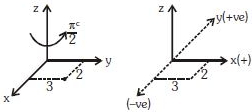
A vector $\vec a = 2\hat i + 3\hat j + 7\hat k$ is there in right handed rectangular coordinate system. The coordinate system is rotated about $z-$ axis from positive $x$ to positive $y-$ axis through angle $\pi /2$ , then new components of $\vec a$ will be
  • A
    $(2, 3, 7)$
  • B
    $(-2, -3, 7)$
  • C
    $(3, -2, -7)$
  • $(3, -2, 7)$

Answer

Correct option: D.
$(3, -2, 7)$
d
There will be no change in $z$ - component

$\therefore $ New component are $(3,-2,7).$

Need a full question paper?

Generate a complete, print-ready paper with questions like this in minutes — across 16+ boards, with answer keys.

Start Generating Free

Similar questions

$f: R \rightarrow R , f(x)=4 x+3$ is defined then, $f^{-1}(x)=$ __________ .
If ${a_{1,}}{a_2},{a_3}.....,{a_n}$ is an $A.P.$ with common difference d then $\tan \left[ {{{\tan }^{ - 1}}\left( {\frac{d}{{1 + {a_1}{a_2}}}} \right) + {{\tan }^{ - 1}}\left( {\frac{d}{{1 + {a_2}{a_3}}}} \right) + ...} \right.$ $\left. { + {{\tan }^{ - 1}}\left( {\frac{d}{{1 + {a_{n - 1}}{a_n}}}} \right)} \right] = $
The system of equations $\lambda x + y + z = 0,$ $ - x + \lambda y + z = 0,$ $ - x - y + \lambda z = 0$, will have a non zero solution if real values of $\lambda $ are given by
The set of all points where the function $f(x)=x+|x|$ is differentiable, is
The solution of the equation $(x + 2{y^3})\frac{{dy}}{{dx}} - y = 0$ is
Which of the given value of x and y make the following pair of matrices equal
$\begin{bmatrix}3\text{x}+7&5\\ \text{y}+1&2-3\text{x}\end {bmatrix},\ \begin{bmatrix}0& \text {y}-2\\8&4 \end{bmatrix}$
  1. $x = \frac{-1}{3}, y = 7$
  2.  Not possible to find
  3. $y = 7, x = \frac{-2}{3}$
  4. $x = \frac{-1}{3}, y = \frac{-2}{3}$
Let $S =\{\sqrt{ n }: 1 \leq n \leq 50$ and $n$ is odd $\}$

Let $a \in S$ and $A =\left[\begin{array}{ccc}1 & 0 & a \\ -1 & 1 & 0 \\ - a & 0 & 1\end{array}\right]$

If $\sum_{ a \in S } \operatorname{det}(\operatorname{adj} A )=100 \lambda$, then $\lambda$ is equal to

$\int_{}^{} {\frac{x}{{{x^4} - 1}}dx = } $
$\int_{ - \pi /4}^{\pi /2} {{e^{ - x}}\sin x\,dx} = $
Choose the correct answer from the given four option.
The solution of the differential equation $\frac{\text{d}\text{y}}{\text{d}\text{x}}=\frac{1+\text{y}^2}{1+\text{x}^2}$ is:
  1. $\text{y}=\tan^{-1}\text{x}$
  2. $\text{y}-\text{x}=\text{k}(1+\text{xy})$
  3. $\text{x}=\tan^{-1}\text{y}$
  4. $\tan(\text{xy})=\text{k}$