MCQ
A vector $\vec{A}$ points towards North and vector $\vec{B}$ points upwards then $\vec{A} \times \vec{B}$ points towards ...........
  • East
  • B
    West
  • C
    North
  • D
    South

Answer

Correct option: A.
East
a
(a)

Here $z$-axis is vertically upward means normal to plane of paper as shown in figure.

Thus, $\overrightarrow{ A }= A \hat{ k }$ and $\overrightarrow{ B }= B \hat{ j }$

So, $\overrightarrow{ A } \times \overrightarrow{ B }= A \hat{ k } \times B \hat{ j }=- AB \hat{ i }$

Thus, it is along negative $x$-axis means along west.

Need a full question paper?

Generate a complete, print-ready paper with questions like this in minutes — across 16+ boards, with answer keys.
Start Generating Free

Similar questions

If a car at rest accelerates uniformly to a speed of 144km/ h in 20s, it covers a distance of:
If $|\overrightarrow A \times \overrightarrow B |\, = \,|\overrightarrow A \,.\,\overrightarrow B |,$ then angle between $\overrightarrow A $ and $\overrightarrow B $ will be ........ $^o$
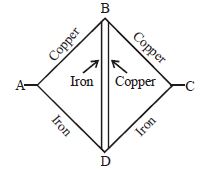
Six wire each of cross-sectional area $A$ and length $l$ are combined as shown in the  figure. The thermal conductivities of copper and iron are $K_1$ and $K_2$ respectively.  The equivalent thermal resistance between points $A$ and $C$ is :-
Work done by gravitational force in one revolution of the earth around the sun on its elliptical path is zero because:
In a city sound intensity level increases uniformly by about $1\ dB$ annually. How many years will it take for intensity of sound to become double ..... $year$
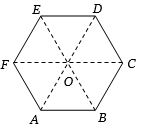
Figure shows $ABCDEF$ as a regular hexagon. What is the value of $\overrightarrow {AB} + \overrightarrow {AC} + \overrightarrow {AD} + \overrightarrow {AE} + \overrightarrow {AF} $ (in $\overrightarrow {AO} $)
A mass $1\, kg$ is suspended by a thread. It is

$(i)\,$ lifted up with an acceleration $4.9\,m/{s^2}$

$(ii) \,$lowered with an acceleration $4.9\,m/{s^2}$.

The ratio of the tensions is

The planet Mars has two moons, if one of them has a period $7\, hours,\, 30\, minutes$ and an orbital radius of $9.0 \times 10^{3}\, {km} .$ Find the mass of Mars.

$\left\{\operatorname{Given} \frac{4 \pi^{2}}{G}=6 \times 10^{11} {N}^{-1} {m}^{-2} {kg}^{2}\right\}$

A motor cycle starts from rest and accelerates along a straight path at $2 \;m / s ^{2}$. At the starting point of the motor cycle there is a stationary electric siren. How far has the motor cycle gone when the driver hears the frequency of the siren at $94 \%$ of its value when the motor cycle was at rest?

(Speed of sound $=330 ms ^{-1}$)

Two rotating bodies $A$ and $B$ of masses $m$ and $2\,m$ with moments of inertia $I_A$ and $I_B (I_B> I_A)$ have equal kinetic energy of rotation. If $L_A$ and $L_B$ be their angular momenta respectively, then