Question
A vertical straight conductor carries a current vertically upwards. A point P lies to the east of it at a small distance and another point Q lies to the west at the same distance. The magnetic field at P is(a) Greater than at Q(b) Same as at Q(c) Less than at Q(d) Greater or less than at Q depending upon the strength of the current


Answer

(b) Same as at Q

Need a full question paper?

Generate a complete, print-ready paper with questions like this in minutes — across 16+ boards, with answer keys.

Start Generating Free

Similar questions

The angle between magnetic meridian and geographical meridian is called :
In the process of electrolysis, the current is carried out inside the electrolyte by(a) Electrons(b) Atoms(c) Positive and negative ions(d) All the above
   
   
Which of the following devices is the more accurate one for the measurement of emf?
If 2.2 kilowatt power is transmitted through a 10 ohm line at 22000 volt, the power loss in the form of heat will be(a) 0.1 watt(b) 1 watt(c) 10 watt(d) 100 watt
       
Which of the following particles will describe the smallest circle when projected with the same velocity perpendicular to a magnetic field?
The work function of aluminium is 4.2 eV.If two photons each of energy 3.5 eV strike an electron of aluminium, then emission of electrons will be:
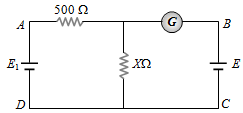
In the adjoining circuit, the battery $E_1$ has an $\text{e.m.f}$ of $12$ volt and zero internal resistance while the battery $E$ has an $\text{e.m.f}$ of $2$ volt. If the galvanometer $G$ reads zero, then the value of the resistance $X$ in ohm is
The X-ray beam emerging from an X-ray tube:
  1. Is monochromatic.
  2. Has all wavelengths smaller than a certain maximum wavelength.
  3. Has all wavelengths greater than a certain minimum wavelength.
  4. Has all wavelengths lying between a minimum and a maximum wavelength.
The quantities remaining constant in a collisions are
  1. Momentum, kinetic energy and temperature.
  2. Momentum and kinetic energy but not temperature.
  3. Momentum and temperature but not kinetic energy.
  4. Momentum, but neither kinetic energy nor temperature.
Solid targets of different elements are bombarded by highly energetic electron beams. The frequency $(f)$ of the characteristic $X-$rays emitted from different targets varies with atomic number $Z$ as