Question
A vertical wire carrying a current in the upward direction is placed in horizontal magnetic field directed towards north. The wire will experience a force directed towards(a) North             (b) South(c) East   (d) West
       

Answer

(d) West

Need a full question paper?

Generate a complete, print-ready paper with questions like this in minutes — across 16+ boards, with answer keys.
Start Generating Free

Similar questions

An infinite number of charges, each of charge $1\mu C,$ are placed on the $x-$axis with co-ordinates $x = 1, 2, 4, 8, ....¥.$ If a charge of $1\ C$ is kept at the origin, then what is the net force acting on $1\ C$ charge
Two capacitors of 10 μF  and 20 μF  are connected in series with a 30V battery. The charge on the capacitors will be, respectively(a) 100 μC, 200 μC(b) 200 μC, 100  μC(c) 100 μC, 100 μC(d) 200 μC, 200 μC
       
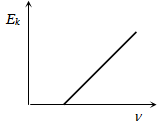
For the photoelectric effect, the maximum kinetic energy $E_k$  of the emitted photoelectrons is plotted against the frequency $n$ of the incident photons as shown in the figure. The slope of the curve gives
If $T$ is the half life of a radioactive material, then the fraction that would remain after a time $\frac{T}{2}$ is
What was the fissionable material used in bomb dropped at Nagasaki (Japan) in the year 1945 ?(a) Uranium(b) Nepturium(c) Berkalium(d) Plutonium
       
The energy of a hydrogen atom in its ground state is -13.6eV. The energy of the level corresponding to the quantum number n = 2 (first excited state) in the hydrogen atom is(a) – 2.72 eV(b) – 0.85 eV(c) – 0.54 eV(d) – 3.4 eV
       
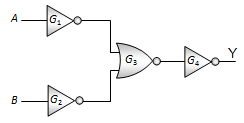
The combination of gates shown below produces
Current $i$ is carried in a wire of length $L .$ If the wire is turned into a circular coil, the maximum magnitude of torque in a given magnetic field $B$ will be
A charged particle $q$ is shot towards another charged particle $Q$ which is fixed, with a speed $v$. It approaches $Q$ upto a closest distance $r$ and then returns. If $q$ were given a speed $2v,$ the closest distances of approach would be
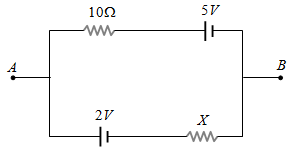
If $V_{AB} = 4V$ in the given figure, then resistance $X$ will be