Question
A very thin film in reflected white light appears:

Answer

  1. black
Explanation:
For very thin films the distance travelled inside the film is insignificant and so the two reflected waves are almost exactly out of phase with each other (due to the phase change at one surface); they interfere destructively and the film appears 'black'.

Need a full question paper?

Generate a complete, print-ready paper with questions like this in minutes — across 16+ boards, with answer keys.
Start Generating Free

Similar questions

A cork floating in a calm pond executes simple harmonic motion of frequency v when a wave generated by a boat passes by it. The frequency of the wave is:
  1. $\text{v}$
  2. $\frac{\text{v}}{2}$
  3. $2\text{v}$
  4. $\sqrt{2}\text{v}.$
A nichrome wire $50 \ cm$ long and one square millimetre cross$-$section carries a current of $4 A$ when connected to a $2 V$ battery. The resistivity of nichrome wire in ohm metre is
In an insulator, the forbidden energy gap between the valence band and conduction band is of the order of:
Visible light passing through a circular hole forms a diffraction disc of radius 0.1mm on a screen. If an X-ray is passed through the same setup, the radius of the diffraction disc will be:
A transmitter supplies 9 kW to the aerial when unmodulated. The power radiated when modulated to 40% is (a) 5 kW(b) 9.72 kW(c) 10 kW(d) 12 kW
       
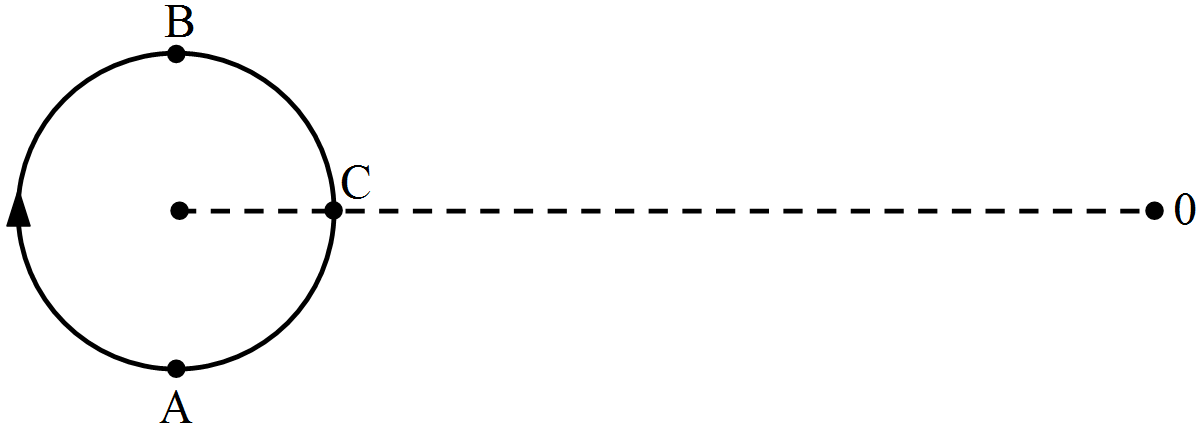
A small source of sound moves on a circle as shown$-$in figure and an observer is sitting at $0$. Let $v_1, v_2, v_3$ be the frequencies heard when the source is at $A, B$ and $C$ respectively.
In interchanging the corresponding positions of battery and galvanometer in a Wheatstone bridge, the balanced position:
Let nh and ne be the number of holes and conduction electrons in an extrinsic semiconductor:
Consider two points $1$ and $2$ in a region outside a charged sphere. Two points are not very far away from the sphere. If $E$ and $V$ represent the electric field vector and the electric potential, which of the following is not possible
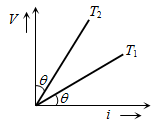
The $V-i$ graph for a conductor at temperature $T_1$ and $T_2$ are as shown in the figure. $(T_2 - T_1)$ is proportional to